Advertisements
Advertisements
प्रश्न
Study the following ray diagram:
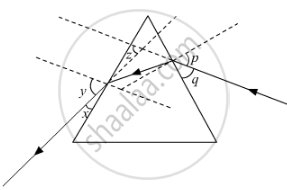
In this diagram, the angle of incidence, the angle of emergence and the angle of deviation respectively have been represented by
(A) y, p, z
(B) x, q, z
(C) p, y, z
(D) p, z, y
Advertisements
उत्तर
Angle p is the angle of incidence since this angle is formed between the incident ray and the normal.
Angle y is the angle of emergence as it is formed between the emergent ray and the normal.
and angle z is the angle of deviation as it is formed between the emergent ray and the incident ray.
Hence, the correct answer is p, y, z
APPEARS IN
संबंधित प्रश्न
A student traces the path of a ray of light through a triangular glass prism for different values of angle of incidence. On analyzing the ray diagrams, which one of the following conclusions is he likely to draw?
(A) The emergent ray is parallel to the incident ray.
(B) The emergent ray bends at an angle to the direction of the incident ray.
(C) The emergent ray and the refracted ray are at right angles to each other.
(D) The emergent ray is perpendicular to the incident ray.
Study the following diagrams in which the path of a ray of light passing through a glass prism as traced by four students P, Q, R and S is shown:

The student who has traced the path correctly is
(A) P
(B) Q
(C) R
(D) S
How could you show that the colours of the spectrum combine to give white light?
A ray of white light is passed through a glass prism and a spectrum is obtained on a screen.
- Name the seven colours of the spectrum in order.
- Do the colours have the same width in the spectrum?
- Which of the colour of the spectrum of white light deviates (i) the most, (ii) the least?
Make the correct choice for each of the following:
Which one of the following Fig correctly shows the path of the ray through the glass block?
The wavelength range of white light is ______.
Observe the given figure and write appropriate phenomenon of light in the box.
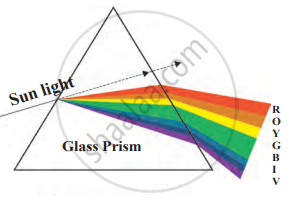
What is dispersion? Explain in detail.
What is a rainbow?
When sunlight passes through water droplets in the atmosphere it gets dispersed into its constituent colours forming a rainbow. A similar phenomenon is observed when white light passes through a prism.
Instead of sunlight, a green-coloured ray is passed through a glass prism. What will be the colour of the emergent ray?
