Advertisements
Advertisements
प्रश्न
How could you show that the colours of the spectrum combine to give white light?
Advertisements
उत्तर
We know that a spectrum of colours is formed when a beam of white light is passed through a transparent glass prism. These colours can be recombined to give white light again. This is achieved by placing another glass prism upside down behind the first prism. A patch of white light is obtained on a screen placed behind the second prism because the refraction produced by the second prism is equal and opposite to the refraction produced by the first prism.
APPEARS IN
संबंधित प्रश्न
A student traces the path of a ray of light through a triangular glass prism for different values of angle of incidence. On analyzing the ray diagrams, which one of the following conclusions is he likely to draw?
(A) The emergent ray is parallel to the incident ray.
(B) The emergent ray bends at an angle to the direction of the incident ray.
(C) The emergent ray and the refracted ray are at right angles to each other.
(D) The emergent ray is perpendicular to the incident ray.
Describe an activity to show that colours of white light splitted by a glass prism can be recombined to get white light by another identical glass prism. Also draw ray diagram to show the recombination of the spectrum of white light.
In the following ray diagram the correctly marked angle are:

(a) ∠i and ∠e
(b) ∠A and ∠D
(c) ∠i, ∠e and ∠D
(d) ∠r, ∠A and ∠D
Study the following ray diagram:
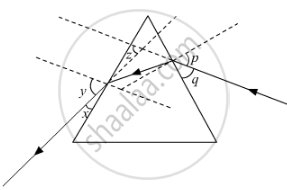
In this diagram, the angle of incidence, the angle of emergence and the angle of deviation respectively have been represented by
(A) y, p, z
(B) x, q, z
(C) p, y, z
(D) p, z, y
In the formation of spectrum of white light by a prism:
- which colour is deviated least?
- which colour is deviated most?
When a ray of light enters a prism, it bends ______ the normal; as it leaves the prism, it bends ______ the normal.
The speed of light in air or vacuum is
In an experiment to trace the path of a ray of light through a glass prism for different values of angle of incidence a student would find that the emergent ray:
(A) is parallel to the incident ray
(B) perpendicular to the incident ray
(C) is parallel to the refracted ray
(D) bends at an angle to the direction of incident ray
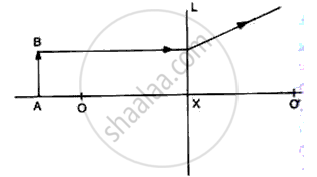
Refer to fig
(i) Name the lens L.
(ii) What are the points O, O' called?
(iii) Complete the diagram to form the image of the object AB.
(iv) Write three characteristics of the image.
A wave has wavelength 50Å of name the wave.
A wave has wavelength 50Å of State its one use.
Which characteristic property of light is responsible for the blue colour of the sky?
Write the range of wavelength of the infrared spectrum.
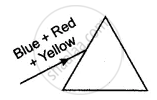
In the figure, a beam of light consisting of three colours blue, red, and yellow is incident on a prism and on a rectangular glass block respectively. Complete the diagram by drawings of the refracted and emergent rays.
Say TRUE or FALSE
After passing through a prism, white light splits into a band of seven colours
What is dispersion? Explain in detail.
Name the scientist who was the first to use a glass prism to obtain the spectrum of sunlight.
______ colour is deviated the least in the spectrum of white light obtained with a glass prism.
dispersive power of crown glass? Given that µv = 1.5230, µr = 1.5145
