Advertisements
Advertisements
Question
How could you show that the colours of the spectrum combine to give white light?
Advertisements
Solution
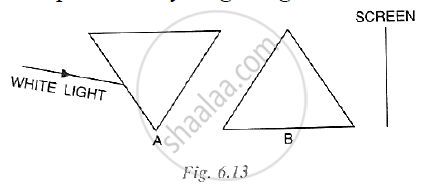
We know that a spectrum of colours is formed when a beam of white light is passed through a transparent glass prism. These colours can be recombined to give white light again. This is achieved by placing another glass prism upside down behind the first prism. A patch of white light is obtained on a screen placed behind the second prism because the refraction produced by the second prism is equal and opposite to the refraction produced by the first prism.
APPEARS IN
RELATED QUESTIONS
Draw a ray diagram to explain the term angle of deviation.
When a beam of white light is passed through a prism, it splits to form lights of seven colours. Is it possible to recombine the lights of seven colours to obtain the white light again? Explain your answer.
What are the seven colours seen in a rainbow?
Which of the following colour of white light is least deviated by the prism?
(a) green
(b) violet
(c) indigo
(d) yellow
Out of the following, the colour of light having the maximum wavelength is:
(a) violet
(b) indigo
(c) green
(d) orange
A ray of light moving from an optically rarer to a denser medium
The seven colours in the spectrum of sunlight in order, are represented as :
State the speed of light in (a) air, (b) water, and (c) glass
Complete the ray diagram given below to show the nature of light produced on the screen.
The frequency range of visible light is from 3.75 × 10¹⁴ Hz to 7.5 × 10¹⁴ Hz. Calculate its wavelength range. Take speed of light = 3 × 10⁸ m/s.
In an experiment to trace the path of a ray of light through a triangular glass prism, a student would observe that the emergent ray
(a) is parallel to the incident ray.
(b) is along the same direction of incident ray.
(c) gets deviated and bends towards the thinner part of the prism.
(d) gets deviated and bends towards the thicker part (base) of the prism.
While performing the experiment to trace the path of a ray of light passing through a glass prism, four students marked the incident ray and the emergent ray in their diagrams in the manner shown below. 
(A) I
(B) II
(C) III
(D) IV
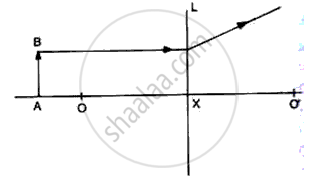
Refer to fig
(i) Name the lens L.
(ii) What are the points O, O' called?
(iii) Complete the diagram to form the image of the object AB.
(iv) Write three characteristics of the image.
The wavelengths of violet and red light are 4000 Å and 8000 Å respectively. Which of the two has the higher frequency?
A wave has wavelength 50Å of State the speed in vacuum.
A student has to trace the path of a ray of light through a glass prism. List four precautions he should observe for better results.
Write the range of wavelength of the ultraviolet spectrum.
Which one of the following is involved for the formation of rainbow in the sky?
What is a rainbow?
When sunlight passes through water droplets in the atmosphere it gets dispersed into its constituent colours forming a rainbow. A similar phenomenon is observed when white light passes through a prism.
Instead of sunlight, a green-coloured ray is passed through a glass prism. What will be the colour of the emergent ray?
