Advertisements
Advertisements
Question
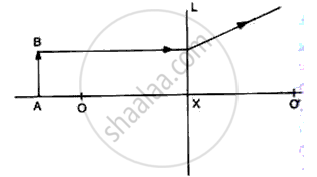
Refer to fig
(i) Name the lens L.
(ii) What are the points O, O' called?
(iii) Complete the diagram to form the image of the object AB.
(iv) Write three characteristics of the image.
Advertisements
Solution
(i) concave lens
(ii) Points O and O' are second focus and first focus respectively.
(iii)

(iv) Characteristics of image : erect, dimnished and virtual.
APPEARS IN
RELATED QUESTIONS
Study the following ray diagram:
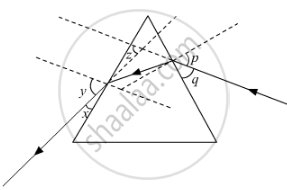
In this diagram, the angle of incidence, the angle of emergence and the angle of deviation respectively have been represented by
(A) y, p, z
(B) x, q, z
(C) p, y, z
(D) p, z, y
In the figure given alongside, a narrow beam of white light is shown to pass through a triangular glass prism. After passing through the prism, it produces a spectrum YX on the screen.
Why do different colours of white light bend through different angles with respect to the incident beam of light?
What acts as tiny prisms in the formation of a rainbow?
The splitting of white light into its constituent colours is called .............
The property of splitting of white light into its seven constituent colours is known as
What conclusion do you draw about the nature of white light in part (b)?
Name the scientist who was the first to use a glass prism to obtain the spectrum of sunlight.
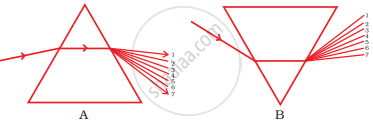
State the correct sequence (1-7) of colours in the spectrum formed by the prisms A and B, shown in the following figure.
A ray of light is incident at 45° on an equilateral prism in the diagram below.

- Name the phenomenon exhibited by the ray of light when it enters and emerges out of the prism.
- State the cause of the above phenomenon mentioned by you.
