Advertisements
Advertisements
Question
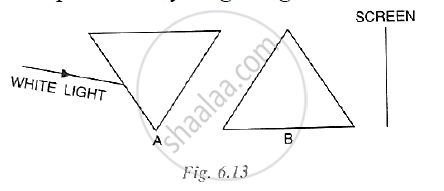
A ray of light is incident at 45° on an equilateral prism in the diagram below.

- Name the phenomenon exhibited by the ray of light when it enters and emerges out of the prism.
- State the cause of the above phenomenon mentioned by you.
Advertisements
Solution
- When light enters the prism and experiences refraction upon exiting, it is said to have undergone dispersion.
- It disperses because the incident light is a polychromatic ray made up of different light wave lengths. As light travels from a denser medium to a rarer medium, refraction takes place.
RELATED QUESTIONS
Study the following diagrams in which the path of a ray of light passing through a glass prism as traced by four students P, Q, R and S is shown:

The student who has traced the path correctly is
(A) P
(B) Q
(C) R
(D) S
Draw a ray diagram to explain the term angle of deviation.
As light rays pass from air into a glass prism, are they refracted towards or away from the normal?
Which of the following colour of white light is least deviated by the prism?
(a) green
(b) violet
(c) indigo
(d) yellow
The splitting of white light into its constituent colours is called .............
Complete the ray diagram given below to show the nature of light produced on the screen.
State two properties of ultraviolet radiation which differ from visible light.
In the diagram, a narrow beam of white light is incident on a right-angled isosceles prism. The critical angle of the material of prism for the yellow colour of white light is 45°. Complete the diagram to show the path of blue, yellow, and red colours of white light till they emerge out of the prism.
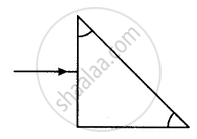
A prism of refractive index `sqrt2` and refracting angle A produces minimum deviation δm of a ray on one face at an angle of incidence 45°, The values of A and δm are, respectively ______.
