Advertisements
Advertisements
प्रश्न
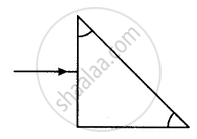
A ray of light is incident at 45° on an equilateral prism in the diagram below.

- Name the phenomenon exhibited by the ray of light when it enters and emerges out of the prism.
- State the cause of the above phenomenon mentioned by you.
Advertisements
उत्तर
- When light enters the prism and experiences refraction upon exiting, it is said to have undergone dispersion.
- It disperses because the incident light is a polychromatic ray made up of different light wave lengths. As light travels from a denser medium to a rarer medium, refraction takes place.
संबंधित प्रश्न
What is spectrum?
In the figure given alongside, a narrow beam of white light is shown to pass through a triangular glass prism. After passing through the prism, it produces a spectrum YX on the screen.
Why do different colours of white light bend through different angles with respect to the incident beam of light?
What are the seven colours seen in a rainbow?
A beam of white light is shone onto a glass prism. The light cannot be:
(a) deviated
(b) dispersed
(c) focused
(d) refracted
The splitting up of white light into seven colours on passing through a glass prism is called ______.
Explain the cause of dispersion of white light through a prism.
Make the correct choice for each of the following:
Which one of the following Fig correctly shows the path of the ray through the glass block?
The wavelength range of white light is ______.
Sunlight entering through a narrow aperture falls on a prism. Draw a neat labelled ray diagram to show the formation of the spectrum on a screen. Name the colour obtained nearer the base of the prism.
In the diagram, a narrow beam of white light is incident on a right-angled isosceles prism. The critical angle of the material of prism for the yellow colour of white light is 45°. Complete the diagram to show the path of blue, yellow, and red colours of white light till they emerge out of the prism.