Advertisements
Advertisements
प्रश्न
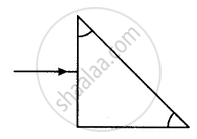
In the diagram, a narrow beam of white light is incident on a right-angled isosceles prism. The critical angle of the material of prism for the yellow colour of white light is 45°. Complete the diagram to show the path of blue, yellow, and red colours of white light till they emerge out of the prism.
Advertisements
उत्तर
The completed diagram is shown below:
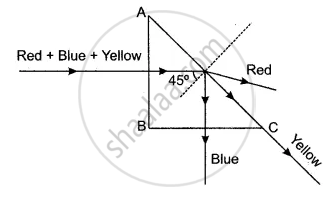
The critical angle for yellow light is given to be 45°. Since μblue > μyellow and μred < μyellow so the critical angle for blue light will be less than 45° and for red light will be more than 45°.
संबंधित प्रश्न
As light rays pass from air into a glass prism, are they refracted towards or away from the normal?
What will happen if another similar glass prism is placed upside down behind the first prism?
The colour of white light which suffers the maximum bending (or maximum refraction) on passing through a glass prism is:
(a) yellow
(b) orange
(c) red
(d) violet
When white light passes through a prism, it ............
What do you understand by the term spectrum?
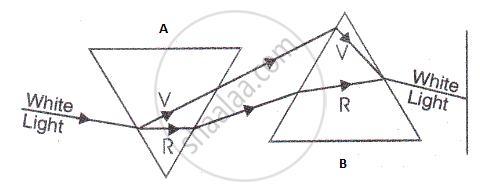
Complete the ray diagram given below to show the nature of light produced on the screen.
The completed ray diagram is as shown below:
Answer the following:
What do you mean by dispersion? Name the different colours of light in the proper sequence in the spectrum of light.
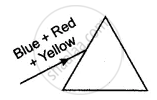
In the figure, a beam of light consisting of three colours blue, red, and yellow is incident on a prism and on a rectangular glass block respectively. Complete the diagram by drawings of the refracted and emergent rays.
The periscope is an optical device with a polished surface that reflects the light falling on it.
During dispersion of white light by prism placed in air, for a particular value of angle of prism,
