Advertisements
Advertisements
Question
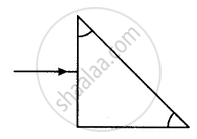
In the diagram, a narrow beam of white light is incident on a right-angled isosceles prism. The critical angle of the material of prism for the yellow colour of white light is 45°. Complete the diagram to show the path of blue, yellow, and red colours of white light till they emerge out of the prism.
Advertisements
Solution
The completed diagram is shown below:
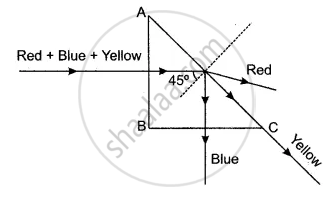
The critical angle for yellow light is given to be 45°. Since μblue > μyellow and μred < μyellow so the critical angle for blue light will be less than 45° and for red light will be more than 45°.
RELATED QUESTIONS
State the cause of dispersion of white light
In the formation of spectrum of white light by a prism:
which colour is deviated most?
Which of the following coloured light has the least speed in glass prism?
(a) violet
(b) yellow
(c) red
(d) green
A glass prism is able to produce the spectrum when white light passes through it, but a glass slab doesn’t produce any spectrum. Explain why it is so.
Which characteristic property of light is responsible for the blue colour of the sky?
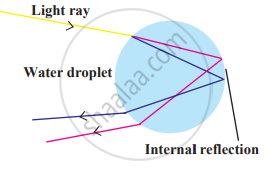
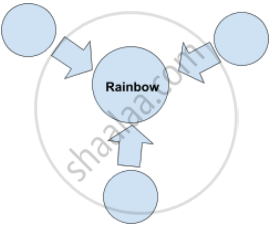
Rainbow is a beautiful natural phenomenon. It is the combined effect of a natural three processes together produced by light. Write it into the circle.
Say TRUE or FALSE
Rainbow is formed by dispersion of which light by water drops
What is a rainbow?
The dispersive powers of flint glass and crown glass are 0.053 and 0.034, respectively and their mean refractive indices are 1.68 and 1.53 for white light. Calculate the angle of the flint glass prism required to form an achromatic combination with a crown glass prism of refracting angle 4°:
Make a rainbow
Try to make your own rainbow. You can try this project in the morning or in the evening. Stand with your back towards the Sun. Take a hosepipe or a water pipe used in the garden. Make a fine spray in front of you. You can see different colours of rainbow in the spray.
