Topics
Gravitation
- Concept of Gravitation
- Force and Motion
- Centripetal Force
- Kepler’s Laws
- Law of Orbit or Kepler's First Law
- Law of Areas or Kepler's Second Law
- Law of Periods or Kepler's Third Law
- Newton's Universal Law of Gravitation
- Uniform Circular Motion (UCM)
- Earth’s Gravitational Force
- Earth’s Gravitational Acceleration
- Mass and Weight
- Gravitational Waves
- Free Fall
- Gravitational Potential Energy
- Escape Velocity
- Weightlessness in Space
Periodic Classification of Elements
- Classification of Elements
- Dobereiner’s Triads
- Newland's Law of Octaves
- Mendeleev’s Periodic Table
- Insights into Mendeleev’s Periodic Table
- Modern Periodic Law
- The Modern Periodic Table
- Structure of the Modern Periodic Table
- Modern Periodic Table and Electronic Configuration of Elements
- Groups and Electronic Configuration
- Periods and Electronic Configuration
- Periodic Trends in the Modern Periodic Table
- Atomic Size
- Metallic and Non-metallic Characters
- Gradation in Halogen Family
Chemical Reactions and Equations
- Chemical Reaction
- Chemical Equations
- Balancing Chemical Equation
- Types of Chemical Reactions > Combination Reaction
- Types of Chemical Reactions > Decomposition Reaction
- Types of Chemical Reactions > Single Displacement Reaction
- Types of Chemical Reactions > Double Displacement Reaction
- Endothermic and Exothermic Processes
- Rate of Chemical Reaction
- Factors Affecting the Rate of a Chemical Reaction
- Chemical Properties of Carbon Compounds > Oxidation
- Chemical Properties of Carbon Compounds > Reduction
- Corrosion of Metals
- Rancidity
Effects of Electric Current
- Electric Circuit
- Heating Effect of Electric Current
- Introduction to Magnetic Effect of Current
- Right-hand Thumb Rule
- Applications of Biot-Savart's Law > Magnetic Field at the Axis of a Circular Current-carrying Loop
- Applications of Ampere’s Circuital Law > Magnetic Field of a Long Straight Solenoid
- Force on a Current-Carrying Conductor Placed in a Uniform Magnetic Field
- Fleming’s Left Hand Rule
- Electric Motor
- Introduction to Electromagnetic Induction
- Galvanometer
- Faraday's Laws of Electromagnetic Induction
- Fleming’s Right Hand Rule
- Alternating current (AC) and Direct Current (DC)
- Electric Generator
Heat
Refraction of Light
Lenses
- Concept of Lenses
- Images Formed by Convex Lenses
- Images Formed by Concave Lenses
- Coordinate Geometry Sign Convention for Measuring Distances and Lengths
- Lens Formula
- Magnification
- Power of a Lens
- Combination of Lenses
- Defects of Vision and Their Corrections > Myopia
- Defects of Vision and Their Corrections > Hypermetropia
- Defects of Vision and Their Corrections > Presbyopia
- Apparent Size of an Object
- Use of Concave Lenses
- Use of Convex Lenses
- Persistence of Vision
Metallurgy
- Physical Properties of Metals
- Physical Properties of Non-metal
- Chemical Properties of Metal
- Reactions of Metals
- Reactivity Series of Metals
- Chemical Properties of Non-metal
- Ionic Compounds
- Metallurgy
- Basic Principles of Metallurgy > Concentration of Ores
- Basic Principles of Metallurgy > Extraction of Metals
- Basic Principles of Metallurgy > Refining of Metals
- Corrosion of Metals
- Prevention of Corrosion
Carbon Compounds
- Bonds in Carbon Compounds
- Carbon: A Versatile Element
- Hydrocarbons
- Straight chains, Branched chains, and Rings of Carbon atoms
- Functional Groups in Carbon Compounds
- Homologous Series
- Nomenclature
- Chemical Properties of Carbon Compounds > Combustion
- Chemical Properties of Carbon Compounds > Oxidation
- Chemical Properties of Carbon Compounds > Addition Reaction
- Chemical Properties of Carbon Compounds > Substitution Reaction
- Ethanol
- Ethanoic Acid
- Macromolecules and Polymers
Space Missions
School of Elements
The Magic of Chemical Reactions
- Chemical Equations
- Types of Chemical Reactions > Combination Reaction
- Types of Chemical Reactions > Decomposition Reaction
- Types of Chemical Reactions > Single Displacement Reaction
- Types of Chemical Reactions > Double Displacement Reaction
- Chemical Properties of Carbon Compounds > Oxidation
- Types of Double Displacement: Neutralization Reaction
The Acid Base Chemistry
- Properties of Acids > Physical Properties
- The pH Scale
- Acids, Bases and Their Reactivity
- Acid or a Base in a Water Solution
- Preparation and Uses of Baking Soda
- Preparation and Uses of Bleaching Powder
- Preparation and Uses of Washing Soda
- Preparation and Uses of Plaster of Paris
- Chemicals from Common Salt - Soap as a Salt
The Electric Spark
All about Electromagnetism
- Magnetic force
- Bar Magnet and Solenoid Analogy
- Right-hand Thumb Rule
- Applications of Biot-Savart's Law > Magnetic Field at the Axis of a Circular Current-carrying Loop
- Applications of Ampere’s Circuital Law > Magnetic Field of a Long Straight Solenoid
- Force on a Current-Carrying Conductor Placed in a Uniform Magnetic Field
- Electric Motor
- Introduction to Electromagnetic Induction
- Alternating-Current Generator
- Simple D.C. Motor
- Household Electrical Circuits
Wonders of Light 1
Wonders of Light 2
Striving for better Environment 1
- Abatement of Pollution
- Sustainable Use of Resources
Dispersion of Light Through a Prism
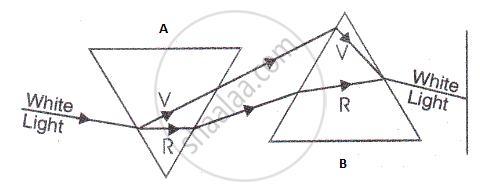
Dispersion occurs when white light passes through a prism and splits into its component colours, forming a spectrum. This happens because different colours of light bend (refract) at different angles as they travel through the prism. The result is a rainbow-like spectrum, consisting of red, orange, yellow, green, blue, indigo, and violet (VIBGYOR). This phenomenon proves that white light is composed of multiple colours, which become visible when dispersed.
- Red light bends the least, while violet light bends the most.
- The bending of light depends on its wavelength and the refractive index of the medium.
- Shorter wavelengths (violet, blue) bend more, and longer wavelengths (red, orange) bend less.
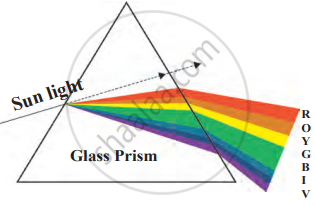
Dispersion of light
Newton’s Disc and the Colours of Light
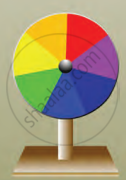
Sir Isaac Newton demonstrated that white light is made up of seven colours using an experiment with a spinning disc.
- Newton created a disc divided into seven sections, each representing one colour of the spectrum (VIBGYOR).
- He rotated the disc rapidly, and the seven colours merged, appearing white.
- This experiment proved that sunlight is composed of seven colours.
- Newton recorded his findings in his book "Opticks," which explained the nature of light.
Wavelength and Speed of Light in Different Media
Light is a type of electromagnetic radiation, and each colour of light has a different wavelength:
- Red light has the longest wavelength (~700 nm).
- Violet light has the shortest wavelength (~400 nm).
- 1 nanometre (nm) = 10⁻⁹ meters.
In a vacuum, all colours of light travel at the same speed. However, in a medium like glass, different colours travel at different speeds due to their different refractive indices. This variation in speed causes the splitting of white light into its component colours, known as dispersion.
- The refractive index of a medium is different for different colours.
- When white light enters a prism, each colour refracts at a different angle, forming a spectrum.
- Red light travels the fastest and bends the least.
- Violet light travels the slowest and bends the most.
This process of light separation into different colours while passing through a medium is called dispersion.
Activity 1
To observe the dispersion of light through water and the formation of a spectrum (rainbow-like colours).
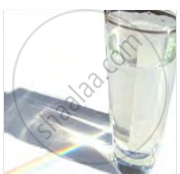
- Place the glass of water on the white sheet of paper near a window where it receives direct sunlight.
- Observe the light passing through the water. You will see a rainbow-like spectrum on the sheet of paper.
Alternative method (in a dark room): Use a prism and a torch instead of the glass and sunlight. Shine the torchlight through the prism, and a similar spectrum will appear on a nearby surface.
This experiment demonstrates how white light is made up of different colours. When light passes through water or a prism, it separates into these colours, forming a spectrum. This is called the dispersion of light.
Activity 2
To observe the dispersion of light and formation of rainbow-like colours in soap bubbles.
- Dip the wire loop in soapy water.
- Blow through the loop to create soap bubbles.
- Observe the bubbles, which display rainbow-like colours.
The colours seen in soap bubbles are due to the dispersion of light and interference of light waves, similar to a rainbow. The soap film acts like a prism, separating light into different colours.
Activity 3
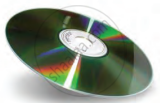
To observe the dispersion of light when sunlight hits a CD.
- Hold the CD in direct sunlight.
- Observe the reflection on the CD surface, which creates a rainbow-like pattern of colours.
The grooves on a CD act like a diffraction grating, separating white light into its component colours, similar to a prism. This shows the dispersion of light and the formation of a spectrum.
Maharashtra State Board: Class 10, 11
CISCE: Class 10
Definition: Dispersion
The phenomenon of splitting of white light by a prism into its constituent colours is known as dispersion.
OR
The splitting of light into its component colours is called dispersion.
OR
The process of separation of light into its component colours while passing through a medium is called the dispersion of light.
OR
The phenomenon in which white light splits into its constituent colours when it passes through a prism or another medium is called dispersion of light.
CISCE: Class 10
Definition: Spectrum
On passing white light through a prism, the band of colours seen on a screen is called the spectrum.
or
The band of the coloured components of a light beam is called its spectrum.
Maharashtra State Board: Class 10
Key Points: Dispersion of Light
- Dispersion is the splitting of white light into seven colours (VIBGYOR) when it passes through a prism or similar transparent medium.
- Human eyes can detect light with wavelengths ranging from 400 nm (violet) to 700 nm (red).
- Different colours travel at different speeds in a medium like glass, so each colour has a different refractive index.
- Violet light bends the most, and red light bends the least, as it passes through a prism, producing a spectrum.
- A rainbow is formed due to dispersion, refraction, and internal reflection of sunlight by raindrops acting as tiny prisms.
Definition: Angular Dispersion
The angular separation between the two extreme rays of a dispersed beam of light is called angular dispersion.
Related QuestionsVIEW ALL [153]
Match the Columns:
| Column ‘A’ | Column ‘B’ |
| The wavelength of red light | (a) 600 nm |
| (b) 700 nm | |
| (c) 500 nm |