Topics
Gravitation
- Concept of Gravitation
- Force and Motion
- Centripetal Force
- Kepler’s Laws
- Law of Orbit or Kepler's First Law
- Law of Areas or Kepler's Second Law
- Law of Periods or Kepler's Third Law
- Newton's Universal Law of Gravitation
- Uniform Circular Motion (UCM)
- Earth’s Gravitational Force
- Earth’s Gravitational Acceleration
- Mass and Weight
- Gravitational Waves
- Free Fall
- Gravitational Potential Energy
- Escape Velocity
- Weightlessness in Space
Periodic Classification of Elements
- Classification of Elements
- Dobereiner’s Triads
- Newland's Law of Octaves
- Mendeleev’s Periodic Table
- Insights into Mendeleev’s Periodic Table
- Modern Periodic Law
- The Modern Periodic Table
- Structure of the Modern Periodic Table
- Modern Periodic Table and Electronic Configuration of Elements
- Groups and Electronic Configuration
- Periods and Electronic Configuration
- Periodic Trends in the Modern Periodic Table
- Atomic Size
- Metallic and Non-metallic Characters
- Gradation in Halogen Family
Chemical Reactions and Equations
- Chemical Reaction
- Chemical Equations
- Balancing Chemical Equation
- Types of Chemical Reactions > Combination Reaction
- Types of Chemical Reactions > Decomposition Reaction
- Types of Chemical Reactions > Single Displacement Reaction
- Types of Chemical Reactions > Double Displacement Reaction
- Endothermic and Exothermic Processes
- Rate of Chemical Reaction
- Factors Affecting the Rate of a Chemical Reaction
- Chemical Properties of Carbon Compounds > Oxidation
- Chemical Properties of Carbon Compounds > Reduction
- Corrosion of Metals
- Rancidity
Effects of Electric Current
- Electric Circuit
- Heating Effect of Electric Current
- Introduction to Magnetic Effect of Current
- Right-hand Thumb Rule
- Applications of Biot-Savart's Law > Magnetic Field at the Axis of a Circular Current-carrying Loop
- Applications of Ampere’s Circuital Law > Magnetic Field of a Long Straight Solenoid
- Force on a Current-Carrying Conductor Placed in a Uniform Magnetic Field
- Fleming’s Left Hand Rule
- Electric Motor
- Introduction to Electromagnetic Induction
- Galvanometer
- Faraday's Laws of Electromagnetic Induction
- Fleming’s Right Hand Rule
- Alternating current (AC) and Direct Current (DC)
- Electric Generator
Heat
Refraction of Light
Lenses
- Concept of Lenses
- Images Formed by Convex Lenses
- Images Formed by Concave Lenses
- Coordinate Geometry Sign Convention for Measuring Distances and Lengths
- Lens Formula
- Magnification
- Power of a Lens
- Combination of Lenses
- Defects of Vision and Their Corrections > Myopia
- Defects of Vision and Their Corrections > Hypermetropia
- Defects of Vision and Their Corrections > Presbyopia
- Apparent Size of an Object
- Use of Concave Lenses
- Use of Convex Lenses
- Persistence of Vision
Metallurgy
- Physical Properties of Metals
- Physical Properties of Non-metal
- Chemical Properties of Metal
- Reactions of Metals
- Reactivity Series of Metals
- Chemical Properties of Non-metal
- Ionic Compounds
- Metallurgy
- Basic Principles of Metallurgy > Concentration of Ores
- Basic Principles of Metallurgy > Extraction of Metals
- Basic Principles of Metallurgy > Refining of Metals
- Corrosion of Metals
- Prevention of Corrosion
Carbon Compounds
- Bonds in Carbon Compounds
- Carbon: A Versatile Element
- Hydrocarbons
- Straight chains, Branched chains, and Rings of Carbon atoms
- Functional Groups in Carbon Compounds
- Homologous Series
- Nomenclature
- Chemical Properties of Carbon Compounds > Combustion
- Chemical Properties of Carbon Compounds > Oxidation
- Chemical Properties of Carbon Compounds > Addition Reaction
- Chemical Properties of Carbon Compounds > Substitution Reaction
- Ethanol
- Ethanoic Acid
- Macromolecules and Polymers
Space Missions
School of Elements
The Magic of Chemical Reactions
- Chemical Equations
- Types of Chemical Reactions > Combination Reaction
- Types of Chemical Reactions > Decomposition Reaction
- Types of Chemical Reactions > Single Displacement Reaction
- Types of Chemical Reactions > Double Displacement Reaction
- Chemical Properties of Carbon Compounds > Oxidation
- Types of Double Displacement: Neutralization Reaction
The Acid Base Chemistry
- Properties of Acids > Physical Properties
- The pH Scale
- Acids, Bases and Their Reactivity
- Acid or a Base in a Water Solution
- Preparation and Uses of Baking Soda
- Preparation and Uses of Bleaching Powder
- Preparation and Uses of Washing Soda
- Preparation and Uses of Plaster of Paris
- Chemicals from Common Salt - Soap as a Salt
The Electric Spark
All about Electromagnetism
- Magnetic force
- Bar Magnet and Solenoid Analogy
- Right-hand Thumb Rule
- Applications of Biot-Savart's Law > Magnetic Field at the Axis of a Circular Current-carrying Loop
- Applications of Ampere’s Circuital Law > Magnetic Field of a Long Straight Solenoid
- Force on a Current-Carrying Conductor Placed in a Uniform Magnetic Field
- Electric Motor
- Introduction to Electromagnetic Induction
- Alternating-Current Generator
- Simple D.C. Motor
- Household Electrical Circuits
Wonders of Light 1
Wonders of Light 2
Striving for better Environment 1
- Abatement of Pollution
- Sustainable Use of Resources
- Key Points: Physical Properties of Metals
Physical Properties
Most metals are solid, but mercury and gallium are liquids at room temperature.
1. Malleability: By repeatedly hammering, the wire becomes flat, forming a thin sheet. Hammering can convert metals into sheets, a property called malleability.
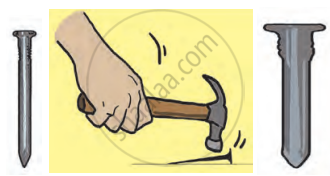
Malleability
2. Ductility: It is a special feature of metals that allows them to be stretched into long, thin wires without breaking.
Examples of Ductile Metals:
- Silver is used in jewellery and electronics.
- Gold is used to make fine jewellery because it can be drawn into thin wires.
- Copper is often used in electrical wiring because it can be quickly drawn into wire and conducts electricity well.
- Platinum is also used in jewellery and various industrial applications.
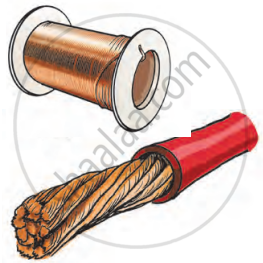
Ductility
3. Electrical conductivity: It is a form of energy that can move or flow through certain materials. Metals like copper, aluminium, and iron are materials through which electricity can flow easily.
Electrical conductivity is a property that tells us how well a material can allow electricity to pass through it. If a material has high electrical conductivity, it means electricity can flow through it very easily. Metals are considered good conductors because they have a lot of free electrons that can move easily.
4. Thermal conductivity: Even when a piece of metal is heated in one place, the whole piece becomes hot. This shows that metals allow heat to flow through them, a property called thermal conductivity.
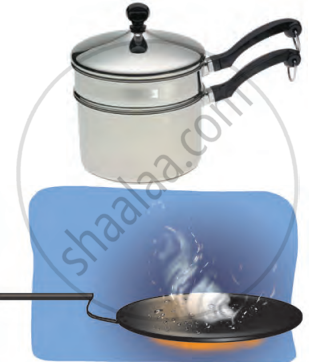
Thermal conductivity
5. Lustre: Metals usually look shiny, and this shine is called lustre. Different metals have different colours. For example, copper is reddish-brown and gold is yellow. This can help you tell one metal from another. Shine and colour are not just for looks; they can tell us a lot about metal, such as what type it is and what it might be used for.
6. Sonority: Metal produces a ring sound. This property is called the sonority of metals.
7. Density: Metals have high density. Sodium, potassium, and lithium are exceptions, having a lower density than water. The density of lithium is only 0.53 g/cc.
8. Melting Point & Boiling Point: Generally, metals have high melting points and boiling points. Exceptions: Hg, Ga, Na, K.
Activity
1. To demonstrate the property of malleability in metals.
- Take a piece of copper or aluminium wire or a small nail.
- Hammer it repeatedly.
- The material flattens and forms a thin sheet.
- This confirms that metals can be shaped into sheets by hammering, demonstrating malleability.
2. Observe the differences in sound produced by various materials when struck or plucked.
- Pluck the string of a musical instrument like a tanpura or veena.
- Ring a bell or hit a steel box with a metal spoon.
- Strike a wooden table or a marble floor with a wooden stick.
- Observe the differences in the sounds produced.
- Metallic objects emit a distinctive ringing sound, demonstrating the sonority of metals.
- Different materials produce different types of sounds when subjected to similar actions.


Uses of metals
Maharashtra State Board: Class 10
Key Points: Physical Properties of Metals
- Metals are mostly solids at room temperature; mercury and gallium are exceptions and exist in liquid form.
- Metals have a shining surface called metallic lustre, which may decrease due to oxidation or reaction with gases.
- Malleability allows metals to be beaten into thin sheets (gold and silver are highly malleable), and ductility allows them to be drawn into wires (gold is the most ductile).
- Metals are good conductors of heat and electricity, with silver and copper being excellent conductors.
- Most metals are hard with high melting and boiling points, but alkali metals (sodium, potassium) are soft and low‑melting, and metals are sonorous, producing sound when struck.
