Topics
Gravitation
- Concept of Gravitation
- Force and Motion
- Circular Motion and Centripetal Force
- Kepler’s Laws
- Law of Orbit or Kepler's First Law
- Law of Areas or Kepler's Second Law
- Law of Periods or Kepler's Third Law
- Newton's Universal Law of Gravitation
- Uniform Circular Motion (UCM)
- Earth’s Gravitational Force
- Earth’s Gravitational Acceleration
- Mass and Weight
- Gravitational Waves
- Free Fall
- Gravitational Potential Energy
- Escape Velocity
- Weightlessness in Space
Periodic Classification of Elements
- Classification of Elements
- Dobereiner’s Triads
- Newland's Law of Octaves
- Mendeleev’s Periodic Table
- Insights into Mendeleev’s Periodic Table
- Modern Periodic Law
- Modern Periodic Table
- Structure of the Modern Periodic Table
- Modern Periodic Table and Electronic Configuration of Elements
- Groups and Electronic Configuration
- Periods and Electronic Configuration
- Periodic Trends in the Modern Periodic Table
- Atomic Size
- Metallic and Non-metallic Characters
- Gradation in Halogen Family
Chemical Reactions and Equations
- Chemical Reaction
- Chemical Equations
- Balancing Chemical Equation
- Types of Chemical Reactions > Combination Reaction
- Types of Chemical Reactions > Decomposition Reaction
- Types of Chemical Reactions > Single Displacement Reaction
- Types of Chemical Reactions > Double Displacement Reaction
- Endothermic and Exothermic Processes
- Rate of Chemical Reaction
- Types of Chemical Reactions > Oxidation and Reduction Reactions
- Corrosion of Metals
- Factors Affecting the Rate of a Chemical Reaction
- Rancidity
Effects of Electric Current
- Electric Circuit
- Heating Effect of Electric Current
- Magnetic Effect of Electric Current
- Right-hand Thumb Rule
- Applications of Biot-Savart's Law > Magnetic Field at the Axis of a Circular Current-carrying Loop
- Applications of Ampere’s Circuital Law > Magnetic Field of a Long Straight Solenoid
- Force on a Current-Carrying Conductor Placed in a Uniform Magnetic Field
- Fleming’s Left Hand Rule
- Electric Motor
- Introduction to Electromagnetic Induction
- Galvanometer
- Faraday's Laws of Electromagnetic Induction
- Fleming’s Right Hand Rule
- Alternating current (AC) and Direct Current (DC)
- Electric Generator
Heat
Refraction of Light
Lenses
- Concept of Lenses
- Images Formed by Convex Lenses
- Images Formed by Concave Lenses
- Sign Convention
- Lens Formula and Magnification
- Magnification
- Power of a Lens
- Combination of Lenses
- Human Eye
- Defects of Vision and Their Corrections > Myopia
- Defects of Vision and Their Corrections > Hypermetropia
- Defects of Vision and Their Corrections > Presbyopia
- Apparent Size of an Object
- Use of Concave Lenses
- Use of Convex Lenses
- Persistence of Vision
Metallurgy
- Physical Properties of Metal
- Physical Properties of Non-metal
- Chemical Properties of Metal
- Reactions of Metals
- Reactivity Series of Metals
- Chemical Properties of Non-metal
- Ionic Compounds
- Metallurgy
- Basic Principles of Metallurgy > Concentration of Ores
- Basic Principles of Metallurgy > Extraction of Metals
- Basic Principles of Metallurgy > Refining of Metals
- Corrosion of Metals
- Prevention of Corrosion
Carbon Compounds
- Bonds in Carbon Compounds
- Carbon: A Versatile Element
- Hydrocarbons
- Straight chains, Branched chains, and Rings of Carbon atoms
- Functional Groups in Carbon Compounds
- Nomenclature
- The IUPAC System of Nomenclature
- Homologous Series
- Chemical Properties of Carbon Compounds > Combustion
- Chemical Properties of Carbon Compounds > Oxidation
- Chemical Properties of Carbon Compounds > Addition Reaction
- Chemical Properties of Carbon Compounds > Substitution Reaction
- Ethanol
- Ethanoic Acid
- Macromolecules and Polymers
Space Missions
School of Elements
The Magic of Chemical Reactions
- Types of Chemical Reactions > Combination Reaction
- Types of Chemical Reactions > Decomposition Reaction
- Types of Chemical Reactions > Single Displacement Reaction
- Types of Chemical Reactions > Double Displacement Reaction
- Chemical Properties of Carbon Compounds > Oxidation
- Types of Double Displacement: Neutralization Reaction
The Acid Base Chemistry
The Electric Spark
All about Electromagnetism
- Magnetic force
- Bar Magnet and Solenoid Analogy
- Right-hand Thumb Rule
- Applications of Biot-Savart's Law > Magnetic Field at the Axis of a Circular Current-carrying Loop
- Applications of Ampere’s Circuital Law > Magnetic Field of a Long Straight Solenoid
- Force on a Current-Carrying Conductor Placed in a Uniform Magnetic Field
- Electric Motor
- Introduction to Electromagnetic Induction
- Alternating-Current Generator
- Simple D.C. Motor
- Household Electrical Circuits
Wonders of Light 1
Wonders of Light 2
Striving for better Environment 1
- Abatement of Pollution
- Sustainable Use of Resources
Definition: Endothermic Process
The process in which heat is absorbed from the outside, is called endothermic process.
Definition: Exothermic Process
The processes in which heat is given out are called exothermic processes.
Definition: Endothermic Reaction
A chemical reaction in which heat is absorbed from the surroundings or must be continuously supplied is called an endothermic reaction.
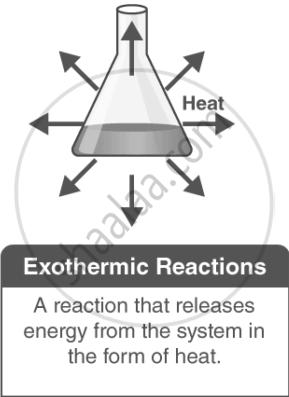
Definition: Exothermic Reaction
A chemical reaction in which heat is released when reactants are converted to products is called an exothermic reaction.
Endothermic Reactions:
In an endothermic reaction, heat is absorbed from the surroundings, causing the temperature of the surroundings to decrease. This means energy acts as a reactant, and the enthalpy change (ΔH) is positive.
Examples of Endothermic Reactions:
1. Decomposition of Calcium Carbonate
- When calcium carbonate (CaCO₃) is heated, it decomposes into calcium oxide (CaO) and carbon dioxide (CO₂) while absorbing heat.
- Equation: CaCO₃(s) + heat → CaO(s) + CO₂(g), ΔH = +177.8 kJ
2. Physical Changes Involving Heat Absorption
- Melting of ice: Ice absorbs heat to become water.
- Dissolution of potassium nitrate (KNO₃) in water: Absorbs heat during dissolution.

Exothermic Reactions:
In an exothermic reaction, heat is released into the surroundings, causing the temperature of the surroundings to increase. Here, energy is a product, and the enthalpy change (ΔH) is negative.
Examples of Exothermic Reactions:
1. Combustion of Methane Gas
- When calcium oxide (CaO) reacts with water (H₂O), it forms calcium hydroxide (Ca(OH)₂) and releases heat.
- Equation: CaO(s) + H₂O(l) → Ca(OH)₂(aq) + heat, ΔH = −890.4 kJ
2. Physical Changes Involving Heat Release
- Freezing of water (formation of ice): Heat is released as water turns into ice.
- Dissolution of sodium hydroxide (NaOH) in water: Produces heat when dissolved.
Precaution in Exothermic Reactions:
- Some exothermic reactions release a large amount of heat rapidly, which can be dangerous. For example, while diluting concentrated sulphuric acid (H₂SO₄) with water, heat is released so quickly that water evaporates instantly, leading to splashes and burns.
- Safety Tip: Always add acid to water slowly with constant stirring to control the heat release and prevent splashing.
Experiment
1. Aim: To observe and compare endothermic and exothermic processes by dissolving potassium nitrate (KNO₃) and sodium hydroxide (NaOH) in water.
2. Requirements
- Apparatus: two plastic bottles, a measuring cylinder, and a thermometer.
- Chemicals: Potassium nitrate (KNO₃), sodium hydroxide (NaOH), water.
(Note: NaOH is corrosive; handle it carefully under supervision.)
3. Procedure
- Take 100 mL of water in each of the two plastic bottles. (Plastic prevents heat dissipation.)
- Measure and record the initial temperature of the water in both bottles.
- Dissolve 5 g of potassium nitrate (KNO₃) in one bottle and shake well.
- Dissolve 5 g of sodium hydroxide (NaOH) in the other bottle and shake well.
- Measure and record the final temperature of both solutions.
4. Observations
- The temperature decreases when KNO₃ dissolves, indicating heat absorption from surroundings (endothermic process).
- The temperature increases when NaOH dissolves, indicating heat release (exothermic process).
5. Conclusion
- The dissolution of KNO₃ is an endothermic process, as heat is absorbed, lowering the solution temperature.
- The dissolution of NaOH is an exothermic process, as heat is released, increasing the solution temperature.
