Topics
Gravitation
- Concept of Gravitation
- Force and Motion
- Circular Motion and Centripetal Force
- Kepler’s Laws
- Law of Orbit or Kepler's First Law
- Law of Areas or Kepler's Second Law
- Law of Periods or Kepler's Third Law
- Newton's Universal Law of Gravitation
- Uniform Circular Motion (UCM)
- Earth’s Gravitational Force
- Earth’s Gravitational Acceleration
- Mass and Weight
- Gravitational Waves
- Free Fall
- Gravitational Potential Energy
- Escape Velocity
- Weightlessness in Space
Periodic Classification of Elements
- Classification of Elements
- Dobereiner’s Triads
- Newland's Law of Octaves
- Mendeleev’s Periodic Table
- Insights into Mendeleev’s Periodic Table
- Modern Periodic Law
- Modern Periodic Table
- Structure of the Modern Periodic Table
- Modern Periodic Table and Electronic Configuration of Elements
- Groups and Electronic Configuration
- Periods and Electronic Configuration
- Periodic Trends in the Modern Periodic Table
- Atomic Size
- Metallic and Non-metallic Characters
- Gradation in Halogen Family
Chemical Reactions and Equations
- Chemical Reaction
- Chemical Equations
- Balancing Chemical Equation
- Types of Chemical Reactions > Combination Reaction
- Types of Chemical Reactions > Decomposition Reaction
- Types of Chemical Reactions > Single Displacement Reaction
- Types of Chemical Reactions > Double Displacement Reaction
- Endothermic and Exothermic Processes
- Rate of Chemical Reaction
- Types of Chemical Reactions > Oxidation and Reduction Reactions
- Corrosion of Metals
- Factors Affecting the Rate of a Chemical Reaction
- Rancidity
Effects of Electric Current
- Electric Circuit
- Heating Effect of Electric Current
- Magnetic Effect of Electric Current
- Right-hand Thumb Rule
- Applications of Biot-Savart's Law > Magnetic Field at the Axis of a Circular Current-carrying Loop
- Applications of Ampere’s Circuital Law > Magnetic Field of a Long Straight Solenoid
- Force on a Current-Carrying Conductor Placed in a Uniform Magnetic Field
- Fleming’s Left Hand Rule
- Electric Motor
- Introduction to Electromagnetic Induction
- Galvanometer
- Faraday's Laws of Electromagnetic Induction
- Fleming’s Right Hand Rule
- Alternating current (AC) and Direct Current (DC)
- Electric Generator
Heat
Refraction of Light
Lenses
- Concept of Lenses
- Images Formed by Convex Lenses
- Images Formed by Concave Lenses
- Sign Convention
- Lens Formula and Magnification
- Magnification
- Power of a Lens
- Combination of Lenses
- Human Eye
- Defects of Vision and Their Corrections > Myopia
- Defects of Vision and Their Corrections > Hypermetropia
- Defects of Vision and Their Corrections > Presbyopia
- Apparent Size of an Object
- Use of Concave Lenses
- Use of Convex Lenses
- Persistence of Vision
Metallurgy
- Physical Properties of Metal
- Physical Properties of Non-metal
- Chemical Properties of Metal
- Reactions of Metals
- Reactivity Series of Metals
- Chemical Properties of Non-metal
- Ionic Compounds
- Metallurgy
- Basic Principles of Metallurgy > Concentration of Ores
- Basic Principles of Metallurgy > Extraction of Metals
- Basic Principles of Metallurgy > Refining of Metals
- Corrosion of Metals
- Prevention of Corrosion
Carbon Compounds
- Bonds in Carbon Compounds
- Carbon: A Versatile Element
- Hydrocarbons
- Straight chains, Branched chains, and Rings of Carbon atoms
- Functional Groups in Carbon Compounds
- Nomenclature
- The IUPAC System of Nomenclature
- Homologous Series
- Chemical Properties of Carbon Compounds > Combustion
- Chemical Properties of Carbon Compounds > Oxidation
- Chemical Properties of Carbon Compounds > Addition Reaction
- Chemical Properties of Carbon Compounds > Substitution Reaction
- Ethanol
- Ethanoic Acid
- Macromolecules and Polymers
Space Missions
School of Elements
The Magic of Chemical Reactions
- Types of Chemical Reactions > Combination Reaction
- Types of Chemical Reactions > Decomposition Reaction
- Types of Chemical Reactions > Single Displacement Reaction
- Types of Chemical Reactions > Double Displacement Reaction
- Chemical Properties of Carbon Compounds > Oxidation
- Types of Double Displacement: Neutralization Reaction
The Acid Base Chemistry
The Electric Spark
All about Electromagnetism
- Magnetic force
- Bar Magnet and Solenoid Analogy
- Right-hand Thumb Rule
- Applications of Biot-Savart's Law > Magnetic Field at the Axis of a Circular Current-carrying Loop
- Applications of Ampere’s Circuital Law > Magnetic Field of a Long Straight Solenoid
- Force on a Current-Carrying Conductor Placed in a Uniform Magnetic Field
- Electric Motor
- Introduction to Electromagnetic Induction
- Alternating-Current Generator
- Simple D.C. Motor
- Household Electrical Circuits
Wonders of Light 1
Wonders of Light 2
Striving for better Environment 1
- Abatement of Pollution
- Sustainable Use of Resources
Maharashtra State Board: Class 10
Direct Current (DC)
Electric current is the flow of electric charge in a circuit. Based on the nature of this flow, current is classified into Direct Current (DC) and Alternating Current (AC).
- DC flows in a single direction and has a constant voltage.
- It is non-oscillatory, meaning it does not change its direction over time.
- It can increase, remain stable, or decrease over time but does not alternate.
Sources of DC:
- Batteries
- Solar cells
- Fuel cells
- DC generators
Uses of DC:
- Mobile phones, flashlights, laptops
- Electric vehicles
- Electronic devices
Graphical Representation of DC:
- A straight line in a graph represents steady DC.
- A sloped or stepped line represents increasing or decreasing DC.

AC current and DC current
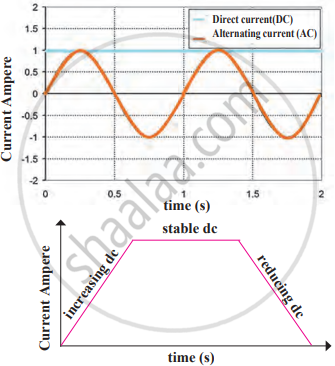
Alternating current and Direct current (Graphical)
Maharashtra State Board: Class 10
Alternating Current (AC)
- Alternating Current (AC) changes its direction and magnitude periodically over time.
- It follows a sinusoidal waveform, moving forward and backward at equal time intervals.
- The number of cycles per second is measured in Hertz (Hz).
- In India, AC frequency is 50 Hz (i.e., 50 cycles per second).
- AC is preferred for power transmission over long distances due to minimal power loss.
Sources of AC:
- Power plants (electricity generation stations)
- Alternators and dynamos
- AC generators
Uses of AC:
- Home electricity supply
- Refrigerators, washing machines, televisions
- Large industries and power stations
Graphical Representation of AC:
- AC follows a sinusoidal wave (S-shaped curve).
- The current moves above and below the zero line, indicating periodic change in direction.
Maharashtra State Board: Class 10
Differences Between AC and DC
| Feature | Alternating Current (AC) | Direct Current (DC) |
| Direction of Flow | Changes periodically | Flows in one direction |
| Voltage Variation | Varies sinusoidally | Remains constant or changes steadily |
| Power Transmission | It can be transmitted over long distances with minimal power loss | It cannot be transmitted efficiently over long distances |
| Frequency | 50 Hz (India), 60 Hz (some countries) | Zero frequency |
| Electron Movement | Moves back and forth periodically | Moves in one direction |
| Generation | Produced by alternators and generators | Generated by batteries, solar cells, and DC generators |
| Usage | It is used in household electricity, industries, and power stations | It is used in batteries, mobile phones, laptops, and electronic devices |
| Graphical Representation | Sinusoidal wave (~) | Straight or dotted line (—) |
Maharashtra State Board: Class 10
Definition: Direct Current (DC)
Direct current is a non-oscillatory current that flows in one direction in a circuit, from the cell to the cell.
Maharashtra State Board: Class 10
Definition: Alternating Current (AC)
Alternating current is a current that changes in magnitude and direction after equal intervals of time.
Shaalaa.com | Alternating current part 2 (AC vs DC : Direct Current)
to track your progress

