Topics
Chemical Reactions and Equations
- Chemical Reaction
- Characteristics of Chemical Reactions
- Chemical Equations
- Balanced and Unbalanced Chemical Equations
- Balancing Chemical Equation
- Types of Chemical Reactions > Combination Reaction
- Types of Chemical Reactions > Decomposition Reaction
- Types of Chemical Reactions > Single Displacement Reaction
- Types of Chemical Reactions > Double Displacement Reaction
- Types of Chemical Reactions > Reversible and Irreversible Reactions
- Types of Chemical Reactions > Oxidation and Reduction Reactions
- Corrosion of Metals
- Rancidity
Chemical Substances-Nature and Behaviour
World of Living
Acids, Bases and Salts
- Introduction to Acids, Bases and Indicators
- Indicators for Testing Acids and Bases
- Acids
- Properties of Acids
- Common Properties of Acids
- Uses of Acids
- Bases
- Properties of Bases
- Uses of Bases
- Chemical Properties of Acids and Bases
- Common Properties of Acids and Bases
- Strength of Acid and Base Solutions : pH Scale
- Universal Indicator
- Importance of pH in Everyday Life
- Salts
- Salts > Family of Salts
- Salts > pH of Salts
- Common Salt
- Sodium hydroxide
- Washing Soda
- Baking Soda
- Bleaching Powder
- Plaster of Paris
- Water of Crystallisation: Hydrated Salts
Metals and Non-metals
Natural Phenomena
Carbon and its Compounds
Effects of Current
Life Processes
Natural Resources
Control and Coordination
How do Organisms Reproduce?
Heredity
Light – Reflection and Refraction
The Human Eye and the Colourful World
- Human Eye
- Working of the Eye
- Rods and Cones
- Power of Accommodation
- Range of Vision of a Normal Human Eye
- Advantages of Having Two Eyes for Vision
- Defects of Vision and Their Corrections > Myopia
- Defects of Vision and Their Corrections > Hypermetropia
- Defects of Vision and Their Corrections > Presbyopia
- Glass Prism
- Refraction of Light through a Prism
- Dispersion of Light Through a Prism
- The Rainbow
- Atmospheric Refraction
- Scattering of Light
Electricity
- Electric Charges
- Conductors and Insulators
- Electric Potential and Potential Difference
- Electric Current
- Electric Circuit
- Circuit Diagram
- Ohm's Law
- Resistance of a Conductor
- Graph Between V and I
- Experiment to Verify Ohm's Law
- Good Conductors, Resistors and Insulators
- Factors Affecting the Resistance of a Conductor
- Resistivity
- Resistance of a System of Resistors
- Resistors in Series
- Resistors in Parallel
- Domestic Electric Circuits: Series or Parallel
- Heating Effect of Electric Current
- Practical Applications of Heating Effect of Electric Current
- Electric Power
- Commercial Unit of Electrical Energy
- Effects Produced by Electric Current
- Applications of the Heating Effect of Current
Magnetic Effects of Electric Current
Our Environment
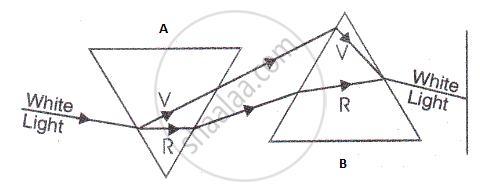
Dispersion of Light Through a Prism
Dispersion occurs when white light passes through a prism and splits into its component colours, forming a spectrum. This happens because different colours of light bend (refract) at different angles as they travel through the prism. The result is a rainbow-like spectrum, consisting of red, orange, yellow, green, blue, indigo, and violet (VIBGYOR). This phenomenon proves that white light is composed of multiple colours, which become visible when dispersed.
- Red light bends the least, while violet light bends the most.
- The bending of light depends on its wavelength and the refractive index of the medium.
- Shorter wavelengths (violet, blue) bend more, and longer wavelengths (red, orange) bend less.
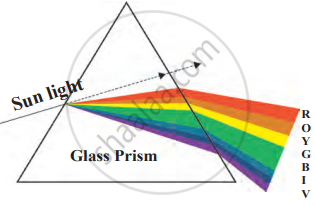
Dispersion of light
Newton’s Disc and the Colours of Light
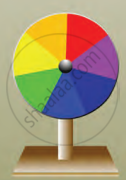
Sir Isaac Newton demonstrated that white light is made up of seven colours using an experiment with a spinning disc.
- Newton created a disc divided into seven sections, each representing one colour of the spectrum (VIBGYOR).
- He rotated the disc rapidly, and the seven colours merged, appearing white.
- This experiment proved that sunlight is composed of seven colours.
- Newton recorded his findings in his book "Opticks," which explained the nature of light.
Wavelength and Speed of Light in Different Media
Light is a type of electromagnetic radiation, and each colour of light has a different wavelength:
- Red light has the longest wavelength (~700 nm).
- Violet light has the shortest wavelength (~400 nm).
- 1 nanometre (nm) = 10⁻⁹ meters.
In a vacuum, all colours of light travel at the same speed. However, in a medium like glass, different colours travel at different speeds due to their different refractive indices. This variation in speed causes the splitting of white light into its component colours, known as dispersion.
- The refractive index of a medium is different for different colours.
- When white light enters a prism, each colour refracts at a different angle, forming a spectrum.
- Red light travels the fastest and bends the least.
- Violet light travels the slowest and bends the most.
This process of light separation into different colours while passing through a medium is called dispersion.
Activity 1
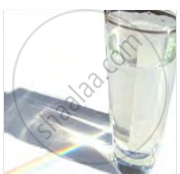
To observe the dispersion of light through water and the formation of a spectrum (rainbow-like colours).
- Place the glass of water on the white sheet of paper near a window where it receives direct sunlight.
- Observe the light passing through the water. You will see a rainbow-like spectrum on the sheet of paper.
Alternative method (in a dark room): Use a prism and a torch instead of the glass and sunlight. Shine the torchlight through the prism, and a similar spectrum will appear on a nearby surface.
This experiment demonstrates how white light is made up of different colours. When light passes through water or a prism, it separates into these colours, forming a spectrum. This is called the dispersion of light.
Activity 2
To observe the dispersion of light and formation of rainbow-like colours in soap bubbles.
- Dip the wire loop in soapy water.
- Blow through the loop to create soap bubbles.
- Observe the bubbles, which display rainbow-like colours.
The colours seen in soap bubbles are due to the dispersion of light and interference of light waves, similar to a rainbow. The soap film acts like a prism, separating light into different colours.
Activity 3
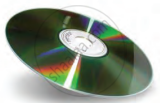
To observe the dispersion of light when sunlight hits a CD.
- Hold the CD in direct sunlight.
- Observe the reflection on the CD surface, which creates a rainbow-like pattern of colours.
The grooves on a CD act like a diffraction grating, separating white light into its component colours, similar to a prism. This shows the dispersion of light and the formation of a spectrum.
Maharashtra State Board: Class 10, 11
CISCE: Class 10
Definition: Dispersion
The phenomenon of splitting of white light by a prism into its constituent colours is known as dispersion.
OR
The splitting of light into its component colours is called dispersion.
OR
The process of separation of light into its component colours while passing through a medium is called the dispersion of light.
OR
The phenomenon in which white light splits into its constituent colours when it passes through a prism or another medium is called dispersion of light.
CISCE: Class 10
Definition: Spectrum
On passing white light through a prism, the band of colours seen on a screen is called the spectrum.
or
The band of the coloured components of a light beam is called its spectrum.
Maharashtra State Board: Class 10
Key Points: Dispersion of Light
- Dispersion is the splitting of white light into seven colours (VIBGYOR) when it passes through a prism or similar transparent medium.
- Human eyes can detect light with wavelengths ranging from 400 nm (violet) to 700 nm (red).
- Different colours travel at different speeds in a medium like glass, so each colour has a different refractive index.
- Violet light bends the most, and red light bends the least, as it passes through a prism, producing a spectrum.
- A rainbow is formed due to dispersion, refraction, and internal reflection of sunlight by raindrops acting as tiny prisms.
Definition: Angular Dispersion
The angular separation between the two extreme rays of a dispersed beam of light is called angular dispersion.