5. Conclusion: The experiments show that chemical changes result in the formation of new substances with distinct properties, whereas physical changes are reversible and do not alter the composition of the substance.
Topics
Chemical Reactions and Equations
- Chemical Reaction
- Characteristics of Chemical Reactions
- Chemical Equations
- Balanced and Unbalanced Chemical Equations
- Balancing Chemical Equation
- Types of Chemical Reactions > Combination Reaction
- Types of Chemical Reactions > Decomposition Reaction
- Types of Chemical Reactions > Single Displacement Reaction
- Types of Chemical Reactions > Double Displacement Reaction
- Types of Chemical Reactions > Reversible and Irreversible Reactions
- Types of Chemical Reactions > Oxidation and Reduction Reactions
- Corrosion of Metals
- Rancidity
Chemical Substances-Nature and Behaviour
World of Living
Acids, Bases and Salts
- Introduction to Acids, Bases and Indicators
- Indicators for Testing Acids and Bases
- Acids
- Properties of Acids
- Common Properties of Acids
- Uses of Acids
- Bases
- Properties of Bases
- Uses of Bases
- Chemical Properties of Acids and Bases
- Common Properties of Acids and Bases
- Strength of Acid and Base Solutions : pH Scale
- Universal Indicator
- Importance of pH in Everyday Life
- Salts
- Salts > Family of Salts
- Salts > pH of Salts
- Common Salt
- Sodium hydroxide
- Washing Soda
- Baking Soda
- Bleaching Powder
- Plaster of Paris
- Water of Crystallisation: Hydrated Salts
Natural Phenomena
Metals and Non-metals
Carbon and its Compounds
Effects of Current
Life Processes
Natural Resources
Control and Coordination
How do Organisms Reproduce?
- DNA Copying and Variation
- The Importance of Variation
- Reproduction
- Modes of Reproduction
- Asexual Reproduction
- Asexual Reproduction in Unicellular Organisms > Binary Fission
- Binary Fission > Simple Binary Fission
- Binary Fission > Longitudinal Binary Fission
- Binary Fission > Transverse Binary Fission
- Asexual Reproduction in Unicellular Organisms > Multiple Fission
- Asexual Reproduction in Multicellular Organisms > Fragmentation
- Asexual Reproduction in Multicellular Organisms > Regeneration
- Asexual Reproduction in Unicellular Organisms > Budding
- Asexual Reproduction in Multicellular Organisms > Budding
- Asexual Reproduction in Multicellular Organisms > Spore Formation
- Vegetative Reproduction or Vegetative Propagation
- Natural Vegetative Propagation
- Artificial Vegetative Propagation
- Tissue Culture
- Sexual Reproduction
- Sexual Reproduction in Plants
- Pollination
- Self-pollination
- Cross-pollination
- Fertilisation in Flowering Plants
- Formation of Seed and Fruit
- Seed Germination
- Sexual Reproduction in Animals
- Puberty
- The Male Reproductive System
- The Female Reproductive System
- Fertilization in Humans
- Menstrual Cycle (Ovarian Cycle)
- Major Events of Menstrual Cycle
- Menarche and Menopause
- Birth Control
- Natural Contraceptive Methods
- Artificial Contraceptive Methods
- Induced Abortion or Medical Termination of Pregnancy (MTP)
- Sexually Transmitted Diseases (STD) or Sexually Transmitted Infections (STI)
- Concept of Reproductive Health
Heredity
- Heredity
- Variation
- Accumulation of Variation During Reproduction
- Gregor Johann Mendel – Father of Genetics
- Monohybrid Cross
- Dihybrid Cross
- Characteristics (or Traits) Transmitted to Progeny
- Inheritance of Blood Groups
- Sex Determination in Humans
- Acquired and Inherited Traits
Light – Reflection and Refraction
- Nature of Light
- Reflection of Light
- Reflection of Light from Plane Surfaces: Plane Mirror
- Law of Reflection of Light
- Regular Reflection and Diffuse Reflection of Light
- Objects and Images
- Images Formed by a Plane Mirrors
- The Position of Image Formed in a Plane Mirror
- Uses of Plane Mirrors
- Spherical Mirrors
- Image Formation by Spherical Mirrors
- Rules for Obtaining Images Formed by Concave Mirrors
- Formation of Different Types of Images by a Concave Mirror
- Representation of Images Formed by Spherical Mirrors Using Ray Diagrams
- Sign Convention for Reflection by Spherical Mirrors
- Mirror Formula and Magnification
- Rules for Obtaining Images Formed by Convex Mirrors
- Formation of Image by a Convex Mirror
- Refraction of Light
- Effects of Refraction of Light
- Laws of Refraction of Light
- Refraction through a Rectangular Glass Slab
- The Refractive Index
- Refraction by Spherical Lenses
- Rules for Obtaining Images Formed by Convex Lenses
- Formation of Different Types of Images by a Convex Lens
- Image Formation by Lenses
- Image Formation in Lenses Using Ray Diagrams
- Sign Convention for Reflection by Spherical Mirrors
- Lens Formula and Magnification
- Lens Formula and Magnification Formulae for a Concave Lens
- Power of a Lens
The Human Eye and the Colourful World
- Human Eye
- Working of the Eye
- Rods and Cones
- Power of Accommodation
- Range of Vision of a Normal Human Eye
- Advantages of Having Two Eyes for Vision
- Defects of Vision and Their Corrections > Myopia
- Defects of Vision and Their Corrections > Hypermetropia
- Defects of Vision and Their Corrections > Presbyopia
- Glass Prism
- Refraction of Light through a Prism
- Dispersion of Light Through a Prism
- The Rainbow
- Atmospheric Refraction
- Scattering of Light
Electricity
- Electric Charges
- Conductors and Insulators
- Electric Potential and Potential Difference
- Electric Current
- Electric Circuit
- Circuit Diagram
- Ohm's Law
- Resistance of a Conductor
- Graph Between V and I
- Experiment to Verify Ohm's Law
- Good Conductors, Resistors and Insulators
- Factors Affecting the Resistance of a Conductor
- Resistivity
- Resistance of a System of Resistors
- Resistors in Series
- Resistors in Parallel
- Domestic Electric Circuits
- Heating Effect of Electric Current
- Practical Applications of Heating Effect of Electric Current
- Electric Power
- Commercial Unit of Electrical Energy
- Effects Produced by Electric Current
- Applications of the Heating Effect of Current
Magnetic Effects of Electric Current
- Introduction to Magnets and Their Properties
- Electromagnetism
- Magnetic Field and Field Lines
- Magnetic Field of Earth
- Magnetic Effect of Current (or Electromagnetism)
- Magnetic Field Due to a Current-Carrying Conductor
- Magnetic Field due to a Current through a Straight Conductor
- Right-hand Thumb Rule
- Magnetic Field due to a Current through a Circular Loop
- Magnetic Field due to a Current in a Solenoid
- Electromagnet
- Magnetism in Human Beings
- Force on a Current-Carrying Conductor in a Magnetic Field
- Domestic Electric Circuits
Our Environment
Maharashtra State Board: Class 10
Definition: Chemical Change
A chemical change is a process in which the composition of matter changes, resulting in the formation of one or more new substances.
Maharashtra State Board: Class 10
Definition: Reactants
The substances taking part in chemical reaction are called reactants.
Maharashtra State Board: Class 10
Definition: Products
The substances formed as a result of a chemical reaction by formation of new bonds are called products.
Maharashtra State Board: Class 8
Types of Chemical Reaction:
| Type of reaction | Definition | Equation |
| Combination | Two or more elements or compounds combine to make a more complex substance. | A + B = AB |
| Decomposition | Compounds break down into simpler substances. | AB = A + B |
| Replacement | Occurs when one element replaces another in a compound | AB + C = AC + B |
| Double replacement | Occurs when different atoms in two different compounds trade places | AB + CD = AC + BD |
Maharashtra State Board: Class 10
Experiment
1. Aim: To observe and differentiate between chemical and physical changes through various experiments.
2. Requirements
- Apparatus: thermometer, evaporating dish, tripod stand, funnel, Bunsen burner.
- Chemicals: limestone powder (CaCO₃), copper sulphate (CuSO₄), zinc dust (Zn), potassium chromate (K₂CrO₄), barium sulphate (BaSO₄), sodium carbonate (Na₂CO₃), calcium chloride (CaCl₂), and phthalic anhydride.
3. Procedure
- Heat limestone powder strongly in an evaporating dish over a high blue flame.
- Add zinc dust into the copper sulphate solution and observe any changes.
- Mix potassium chromate solution with barium sulphate solution and note the reaction.
- Add sodium carbonate solution to calcium chloride solution and observe any precipitate formation.
- Heat phthalic anhydride in an evaporating dish with an inverted funnel placed over it and observe changes.
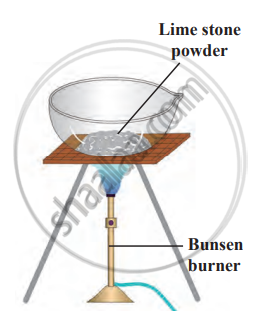
To heat limestone powder
4. Observation
| Activity | Colour Change (if present) | Gas Released (Yes/No) | Temperature Change (if present) | Nature of Change (Chemical/Physical) |
|---|---|---|---|---|
| 1 | No | Yes | Yes | Chemical |
| 2 | Yes | No | Yes | Chemical |
| 3 | Yes | No | Yes | Chemical |
| 4 | Yes | No | Yes | Chemical |
| 5 | No | No | No | Physical |
Shaalaa.com | Types of Chemical Reactions
to track your progress
Related QuestionsVIEW ALL [406]
MATCH THE COLUMNS
| 1 . `H_2` + `CI_2` `→` 2HCI | a. displacement reaction |
| 2. `2FeCI_3`+ `H_2` `→` `2FeCI_2` +2HCI` | b. addition of an electronegative redical |
| 3. Fe + `CuSO_4` `→``FeSO_4` +Cu` | c. removal of an electronegative redical |
| 4. `2H_2O` +`4NO_2`+`O_2` `→` `4HNO_3` | d.reduction by adding hydrogen |
| 5. 3Fe +`3CI_2` `→` `2FeCI_3` | e.electrolysis of water |
| 6. `FeCI_3`+ 3NaOH `→``Fe(OH)_3``↓`+NaCI | F.double decomposition,precipitation reaction |
| 7.`2H_2O` `→` `2H_2``↑`+`O_2` | e. combination or synthesis reaction |
Complete the table given below.
| Addition of dil. H2SO4 to KHCO3 | Name of residue obtained |
