English

Hydrocarbons

Advertisements

Topics

  • Definition: Hydrocarbons
  • Definition: Saturated Hydrocarbons
  • Definition: Unsaturated Hydrocarbons
  • Definition: Alkanes
  • Definition: Alkenes
  • Definition: Alkynes
  • Key Points: Hydrocarbons
Maharashtra State Board: Class 9

Introduction:

A hydrocarbon is a type of organic chemical compound made up only of carbon (C) and hydrogen (H) atoms. The carbon atoms form the structure of the compound, while hydrogen atoms are attached to them in various arrangements.

  • Hydrocarbons are the main components of petroleum and natural gas. Carbon, with an electronic configuration of 2,4, requires four additional electrons to complete its octet and become stable like the inert gas neon (2,8).
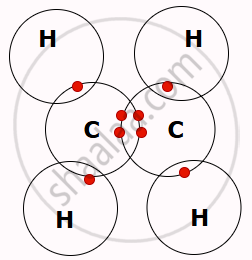
  • Instead of gaining or losing electrons, carbon shares its electrons through covalent bonding. This allows a carbon atom to form four covalent bonds, either with other carbon atoms or with atoms of other elements.
  • For example, when a carbon atom bonds with four hydrogen atoms by sharing electrons, it forms a methane molecule (CH₄), which is the simplest hydrocarbon.
  • They are widely used as fuels and lubricants and serve as raw materials for producing plastics, fibres, rubbers, solvents, explosives, and many industrial chemicals.
Maharashtra State Board: Class 9

Properties of Covalent Compounds:

Covalent compounds generally have low melting and boiling points because their intermolecular forces are weak. They are usually insoluble in water but dissolve in organic solvents, like alcohol or ether. These compounds are poor conductors of heat and electricity because they lack free electrons or ions.

  • Covalent compounds often exist as gases, liquids, or soft solids due to their molecular structure.
  • They tend to exhibit directional bonding, which allows for complex structures like chains, rings, and networks.
  • These compounds are found abundantly in nature, forming the basis of organic life and synthetic materials like plastics and fuels.
Maharashtra State Board: Class 9

Saturated Hydrocarbons:

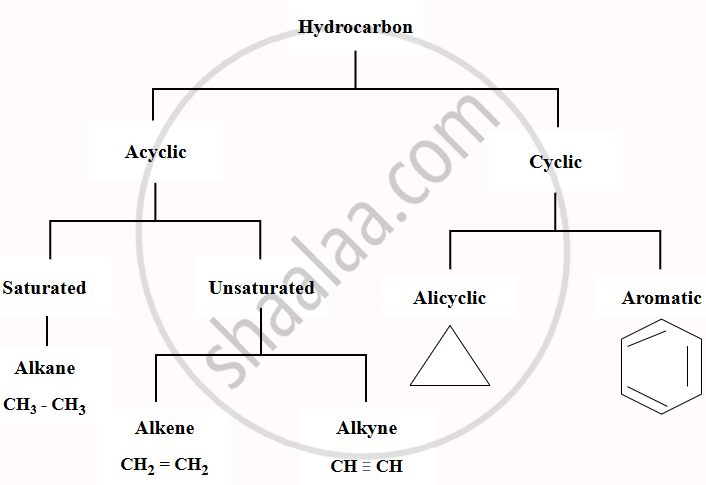
Saturated hydrocarbons are hydrocarbons in which all carbon atoms are bonded to other atoms through single covalent bonds (C–C). Each carbon atom forms four single bonds, fully occupying its bonding capacity. They are the simplest and least polar organic compounds found in nature. Examples of saturated hydrocarbons include the alkane and cycloalkane families.

General formula: CₙH₂ₙ₊₂

For example:

Line structure / structural formula of ethane

\[\begin{array}{cc}
\ce{\phantom{}H\phantom{..}H}\\
\phantom{}|\phantom{...}|\\
\ce{H-C-C-H}\\
\phantom{}|\phantom{...}|\\
\ce{\phantom{}H\phantom{..}H}\\
\end{array}\]

Electron-dot structure of ethane

\[\begin{array}{cc}
\phantom{}\ce{H}\phantom{....}\ce{H}\phantom{}\\
\phantom{}\ce{H}\phantom{..}\ce{\text{}^\bullet_\bullet}\phantom{..}\ce{\overset{\bullet\phantom{.}\bullet}{\underset{\bullet\phantom{.}\bullet}{C}}}\phantom{..}\ce{\text{}^\bullet_\bullet}\phantom{..}\ce{\overset{\bullet\phantom{.}\bullet}{\underset{\bullet\phantom{.}\bullet}{C}}}\phantom{..}\ce{\text{}^\bullet_\bullet}\phantom{..}\ce{H}\phantom{}\\
\phantom{}\ce{H}\phantom{....}\ce{H}\phantom{}\\
\end{array}\]

Maharashtra State Board: Class 9

Unsaturated Hydrocarbons:

Unsaturated hydrocarbons are hydrocarbons that contain one or more double or triple bonds between carbon atoms. More reactive than saturated hydrocarbons. Furthermore, their reactivity increases with the number of multiple bonds present in the main carbon chain.

Two types:

1. Alkenes – Have at least one double bond (C=C).

General Formula: CnH2n

2. Alkynes – Have at least one triple bond (C≡C).

General Formula: CnH(2n-2)

For example:

Line structure/ structural formula

\[\begin{array}{cc}
\ce{\phantom{}H\phantom{..}H}\\
\phantom{}|\phantom{...}|\\
\ce{C=C}\\
\phantom{}|\phantom{...}|\\
\ce{\phantom{}H\phantom{..}H}\\
\end{array}\]

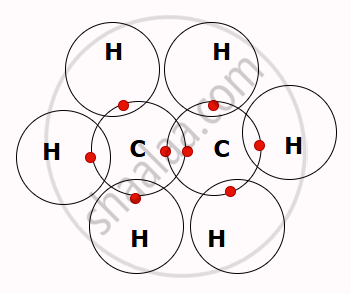
Electron-dot structures of ethene

\[\begin{array}{cc}
\phantom{...}\ce{H}\phantom{......}\ce{H}\phantom{.}\\
\phantom{..}\ce{\overset{\bullet\phantom{.}\bullet}{\underset{\bullet\phantom{.}\bullet}{C}}}\phantom{..}\ce{\text{}^\bullet_\bullet}\phantom{}\ce{\text{}^\bullet_\bullet}\phantom{..}\ce{\overset{\bullet\phantom{.}\bullet}{\underset{\bullet\phantom{.}\bullet}{C}}}\\
\phantom{...}\ce{H}\phantom{......}\ce{H}\phantom{.}\\
\end{array}\]

Ethyne (CH≡CH)

\[\begin{array}{cc}
\ce{H-C ≡ C-H}\\
\end{array}\]

Propene (CH₃-CH=CH₂)

\[\begin{array}{cc}
\ce{\phantom{....}H\phantom{..}H\phantom{..}H}\\
\phantom{....}|\phantom{...}|\phantom{...}|\\
\ce{H-C-C=C}\\
\phantom{....}|\phantom{......}|\\
\ce{\phantom{....}H\phantom{.....}H}
\end{array}\]

Propyne (CH≡C-CH₃)

\[\begin{array}{cc}
\ce{\phantom{.......}H}\\
\phantom{..........}|\phantom{...}\\
\ce{H-C≡C-C-H}\\
\phantom{.......}|\\
\ce{\phantom{.......}H}
\end{array}\]

Maharashtra State Board: Class 10
CISCE: Class 10

Definition: Hydrocarbons

Hydrocarbons are compounds that 9re made up only of carbon and hydrogen atoms.

OR

The compounds which contain carbon and hydrogen as the only two elements are called hydrocarbons.

Maharashtra State Board: Class 10

Definition: Saturated Hydrocarbons

Saturated hydrocarbons are hydrocarbons in which the valencies of all atoms are satisfied by single bonds.

Maharashtra State Board: Class 10
CISCE: Class 10

Definition: Unsaturated Compounds

The hydrocarbons that have double or triple covalent bonds between two adjacent carbon atoms are called unsaturated hydrocarbons.

OR

The carbon compounds having a double bond or triple bond between two carbon atoms are called unsaturated compounds. Ethene and ethyne are unsaturated hydrocarbons.

Maharashtra State Board: Class 10

Definition: Alkanes

Saturated hydrocarbons (containing a single bond) are called ‘Alkanes’.

Maharashtra State Board: Class 10

Definition: Alkenes

The unsaturated hydrocarbons containing a carbon-carbon double bond are called ‘Alkenes’.

Maharashtra State Board: Class 10

Definition: Alkynes

The unsaturated hydrocarbons whose structures contain a carbon-carbon triple bond are called ‘Alkynes’.

Maharashtra State Board: Class 10

Key Points: Hydrocarbons

  • Hydrocarbons contain only carbon and hydrogen atoms and are the basic type of organic compounds.
  • Saturated hydrocarbons have single bonds (e.g. methane, ethane, propane).
  • Unsaturated hydrocarbons have double or triple bonds (e.g. ethene, ethyne).
  • To draw structures, join the carbon atoms first, then add hydrogen atoms to complete 4 bonds per carbon.
  • Ethene has a double bond, and ethyne has a triple bond between carbon atoms.
Advertisements
Share
Notifications

Englishहिंदीमराठी


      Forgot password?
Use app×