Topics
Gravitation
- Concept of Gravitation
- Force and Motion
- Circular Motion and Centripetal Force
- Kepler’s Laws
- Law of Orbit or Kepler's First Law
- Law of Areas or Kepler's Second Law
- Law of Periods or Kepler's Third Law
- Newton's Universal Law of Gravitation
- Uniform Circular Motion (UCM)
- Earth’s Gravitational Force
- Earth’s Gravitational Acceleration
- Mass and Weight
- Gravitational Waves
- Free Fall
- Gravitational Potential Energy
- Escape Velocity
- Weightlessness in Space
Periodic Classification of Elements
- Classification of Elements
- Dobereiner’s Triads
- Newland's Law of Octaves
- Mendeleev’s Periodic Table
- Insights into Mendeleev’s Periodic Table
- Modern Periodic Law
- Modern Periodic Table
- Structure of the Modern Periodic Table
- Modern Periodic Table and Electronic Configuration of Elements
- Groups and Electronic Configuration
- Periods and Electronic Configuration
- Periodic Trends in the Modern Periodic Table
- Atomic Size
- Metallic and Non-metallic Characters
- Gradation in Halogen Family
Chemical Reactions and Equations
- Chemical Reaction
- Chemical Equations
- Balancing Chemical Equation
- Types of Chemical Reactions > Combination Reaction
- Types of Chemical Reactions > Decomposition Reaction
- Types of Chemical Reactions > Single Displacement Reaction
- Types of Chemical Reactions > Double Displacement Reaction
- Endothermic and Exothermic Processes
- Rate of Chemical Reaction
- Types of Chemical Reactions > Oxidation and Reduction Reactions
- Corrosion of Metals
- Factors Affecting the Rate of a Chemical Reaction
- Rancidity
Effects of Electric Current
- Electric Circuit
- Heating Effect of Electric Current
- Magnetic Effect of Electric Current
- Right-hand Thumb Rule
- Applications of Biot-Savart's Law > Magnetic Field at the Axis of a Circular Current-carrying Loop
- Applications of Ampere’s Circuital Law > Magnetic Field of a Long Straight Solenoid
- Force on a Current-Carrying Conductor Placed in a Uniform Magnetic Field
- Fleming’s Left Hand Rule
- Electric Motor
- Introduction to Electromagnetic Induction
- Galvanometer
- Faraday's Laws of Electromagnetic Induction
- Fleming’s Right Hand Rule
- Alternating current (AC) and Direct Current (DC)
- Electric Generator
Heat
Refraction of Light
Lenses
- Concept of Lenses
- Images Formed by Convex Lenses
- Images Formed by Concave Lenses
- Sign Convention
- Lens Formula and Magnification
- Magnification
- Power of a Lens
- Combination of Lenses
- Human Eye
- Defects of Vision and Their Corrections > Myopia
- Defects of Vision and Their Corrections > Hypermetropia
- Defects of Vision and Their Corrections > Presbyopia
- Apparent Size of an Object
- Use of Concave Lenses
- Use of Convex Lenses
- Persistence of Vision
Metallurgy
- Physical Properties of Metal
- Physical Properties of Non-metal
- Chemical Properties of Metal
- Reactions of Metals
- Reactivity Series of Metals
- Chemical Properties of Non-metal
- Ionic Compounds
- Metallurgy
- Basic Principles of Metallurgy > Concentration of Ores
- Basic Principles of Metallurgy > Extraction of Metals
- Basic Principles of Metallurgy > Refining of Metals
- Corrosion of Metals
- Prevention of Corrosion
Carbon Compounds
- Bonds in Carbon Compounds
- Carbon: A Versatile Element
- Hydrocarbons
- Straight chains, Branched chains, and Rings of Carbon atoms
- Functional Groups in Carbon Compounds
- Nomenclature
- The IUPAC System of Nomenclature
- Homologous Series
- Chemical Properties of Carbon Compounds > Combustion
- Chemical Properties of Carbon Compounds > Oxidation
- Chemical Properties of Carbon Compounds > Addition Reaction
- Chemical Properties of Carbon Compounds > Substitution Reaction
- Ethanol
- Ethanoic Acid
- Macromolecules and Polymers
Space Missions
School of Elements
The Magic of Chemical Reactions
- Types of Chemical Reactions > Combination Reaction
- Types of Chemical Reactions > Decomposition Reaction
- Types of Chemical Reactions > Single Displacement Reaction
- Types of Chemical Reactions > Double Displacement Reaction
- Chemical Properties of Carbon Compounds > Oxidation
- Types of Double Displacement: Neutralization Reaction
The Acid Base Chemistry
The Electric Spark
All about Electromagnetism
- Magnetic force
- Bar Magnet and Solenoid Analogy
- Right-hand Thumb Rule
- Applications of Biot-Savart's Law > Magnetic Field at the Axis of a Circular Current-carrying Loop
- Applications of Ampere’s Circuital Law > Magnetic Field of a Long Straight Solenoid
- Force on a Current-Carrying Conductor Placed in a Uniform Magnetic Field
- Electric Motor
- Introduction to Electromagnetic Induction
- Alternating-Current Generator
- Simple D.C. Motor
- Household Electrical Circuits
Wonders of Light 1
Wonders of Light 2
Striving for better Environment 1
- Abatement of Pollution
- Sustainable Use of Resources
Reaction of Metals with Oxygen
Metals react with oxygen to form metal oxides. The rate of reaction depends on the metal’s reactivity. Highly reactive metals, such as sodium and potassium, react at room temperature, while others, like magnesium, require heating.
1. Highly reactive metals (e.g., sodium, potassium) react at room temperature:
4Na(s) + O₂(g) → 2Na₂O(s)
Sodium is stored in kerosene to prevent accidental combustion.
2. Moderately reactive metals (e.g., magnesium) react upon heating:
Na₂O(s) + H₂O(l) → 2NaOH(aq)
Magnesium oxide reacts with water to form magnesium hydroxide:
2Mg(s) + O₂(g) → 2MgO(s)
Reaction of Metals with Water
The reaction of metals with water varies depending on their reactivity. Some metals react violently, some react slowly, and others do not react at all.
1. Highly reactive metals (e.g., sodium, potassium) react explosively, producing hydrogen gas and heat:
2Na(s) + 2H₂O(l) → 2NaOH(aq) + H₂(g) + heat
2K(s) + 2H₂O(l) → 2KOH(aq) + H₂(g) + heat
2. Moderately reactive metals (e.g., calcium) react slowly, producing hydrogen gas in the form of bubbles:
2Ca(s) + 2H₂O(l) → 2Ca(OH)₂(aq) + H₂(g)
3. Less reactive metals (e.g., aluminium, zinc, iron) do not react with cold or hot water but react with steam:
2Al(s) + 3H₂O(g) → Al₂O₃(s) + 3H₂(g)
3Fe(s) + 4H₂O(g) → Fe₃O₄(s) + 4H₂(g)
Experiment 1
1. Aim: To observe how different metals react with water.
2. Requirements: Beakers, water, and metal samples (excluding sodium for safety).
3. Procedure
- Drop a small piece of each metal into separate beakers filled with water.
- Observe whether the metal reacts, floats, or sinks.
- Record reaction rate, gas formation, and heat generation.
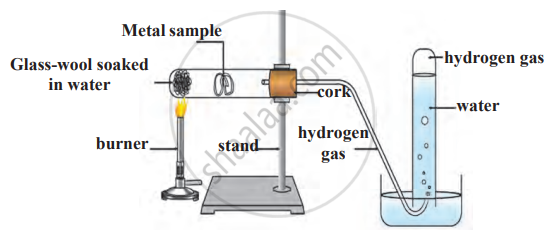
Reaction of a metal with water
4. Observations
- Sodium and potassium react violently.
- Calcium reacts slowly, forming bubbles.
- Zinc, iron, and aluminium react only with steam.
5. Conclusion: Metals have different reactivity levels with water. Highly reactive metals produce hydrogen gas and form alkalis, while less reactive metals react only with steam.
Reaction of Metals with Acids
Most metals react with dilute acids to form salt and hydrogen gas. The reactivity of metals varies, with some reacting vigorously and others reacting slowly.
Reactivity order: Mg > Al > Zn > Fe
1. Highly reactive metals (e.g., magnesium) react vigorously:
Mg(s) + 2HCl(aq) → MgCl₂(aq) + H₂(g)
2. Moderately reactive metals (e.g., aluminium, zinc, iron) react at different speeds:
2Al(s)+6HCl(aq)→2AlCl₃(aq)+3H₂(g)
Fe(s) + 2HCl(aq) → FeCl₂(aq) + H₂(g)
Zn(s) + HCl(aq) → ZnCl₂(aq) + H₂(g)
The hydrogen gas released can be tested by bringing a burning splint near it, which produces a ‘pop’ sound.
Experiment 2
1. Aim: To study the reaction of metals with dilute acids.
2. Requirements: Test tubes, dilute hydrochloric acid, and samples of magnesium, aluminium, zinc, and iron.
3. Procedure
- Add a small piece of each metal to separate test tubes containing dilute hydrochloric acid.
- Observe gas bubble formation.
- Test the gas with a burning splint.
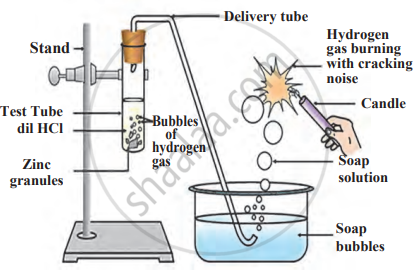
Reaction of metals with dilute acid
4. Observations
- Magnesium reacts vigorously, producing hydrogen gas.
- Aluminium, zinc, and iron react at different speeds.
- The gas burns with a ‘pop’ sound.
5. Conclusion: Metals react with acids to form salts and hydrogen gas. The reaction speed varies with different metals.
Reaction of Metals with Nitric Acid
Metals react with nitric acid to form metal nitrates and release nitrogen oxides (NO, NO₂, or N₂O) instead of hydrogen gas. This is because nitric acid is a strong oxidising agent, which oxidises the hydrogen gas into water. However, magnesium and manganese react with very dilute nitric acid to produce hydrogen gas.
1. Reaction with concentrated nitric acid
Copper reacts with concentrated nitric acid to form copper nitrate and nitrogen dioxide gas:
Cu(s) + 4HNO₃(aq) → Cu(NO₃)₂(aq) + 2NO₂(g) + 2H₂O(l)
NO gas is colourless but turns brown in air due to oxidation into NO₂.
2. Reaction with dilute nitric acid
Copper reacts with dilute nitric acid to form copper nitrate and nitric oxide (NO) gas:
3Cu(s) + 8HNO₃(aq) → 3Cu(NO₃)₂(aq) + 2NO(g) + 4H₂O(l)
Aqua Regia: It is a highly corrosive mixture of concentrated hydrochloric acid (HCl) and nitric acid (HNO₃) in a 3:1 ratio. It dissolves noble metals like gold and platinum, which do not react with nitric acid alone.
Au(s) + HNO₃ + HCl → H[AuCl₄] + NO
Reaction of Metals with Salts of Other Metals
A more reactive metal can displace a less reactive metal from its salt solution. This is known as a displacement reaction.
Iron displaces copper from copper sulphate solution:
Fe(s) + CuSO₄(aq) → FeSO₄(aq) + Cu(s)
The iron nail gets coated with copper, showing that iron is more reactive than copper.
Experiment 3
1. Aim: To observe displacement reactions between metals and metal salts.
2. Requirements: Test tubes, iron nails, copper wire, solutions of copper sulphate and ferrous sulphate.
3. Procedure
- Place an iron nail in copper sulphate solution.
- Place a copper wire in ferrous sulphate solution.
- Observe changes over time.
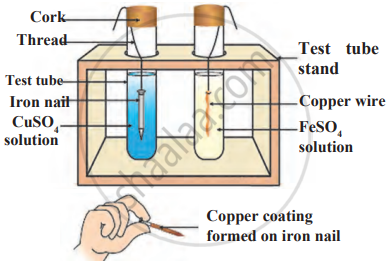
Reaction of metal with solution of salts of other metals
4. Observations
- The iron nail develops a copper coating, indicating a reaction.
- No reaction is seen in the copper wire with ferrous sulphate solution.
5. Conclusion: A more reactive metal can replace a less reactive metal from its salt solution, confirming the reactivity series.
Reaction of Metals with Nonmetals
Metals react with nonmetals to form ionic compounds. This reaction occurs because metals lose electrons to achieve a stable electron configuration, while nonmetals gain electrons to complete their outermost shell. Noble gases (like helium, neon, and argon) do not react because they already have a complete octet, making them chemically inert.
When a metal reacts with a nonmetal, an electron transfer takes place, forming an ionic bond. The metal donates electrons, becoming a cation (+), while the nonmetal accepts electrons, becoming an anion (-).
Example,
1. Formation of Sodium Chloride (NaCl)
2Na(s) + Cl₂(g) → 2NaCl(s)
- Sodium (Na) loses one electron to form Na⁺.
- Chlorine (Cl₂) gains electrons to form Cl⁻.
- The oppositely charged ions attract, forming an ionic bond in NaCl.
Similarly, magnesium and potassium also form ionic compounds with chlorine:
2. Formation of Magnesium Chloride (MgCl₂)
Mg(s) + Cl₂(g) → MgCl₂(s)
- Magnesium loses two electrons to form Mg²⁺.
- Each chlorine atom gains one electron, forming Cl⁻ ions.
3. Formation of Potassium Chloride (KCl)
K(s) + Cl₂(g) → 2KCl(s)
- Potassium loses one electron to form K⁺.
- Chlorine gains an electron to form Cl⁻.
Key Points: Reactions of Metals
- Metals react with oxygen to form metal oxides; some oxides dissolve in water to form alkalis (e.g., Na₂O → NaOH, MgO → Mg(OH)₂).
- Highly reactive metals like sodium and potassium react vigorously with water, producing hydrogen gas and heat, while calcium reacts slowly.
- Aluminium, iron, and zinc do not react with cold water but react with steam to form metal oxides and hydrogen gas.
- Reactive metals react with dilute acids (HCl, H₂SO₄) to form metal salts and hydrogen gas, showing different reactivity levels (Mg > Al > Zn > Fe).
- A more reactive metal displaces a less reactive metal from its salt solution, indicating a displacement reaction; noble metals like gold and platinum react only with aqua regia.
