Advertisements
Advertisements
Questions
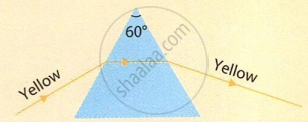
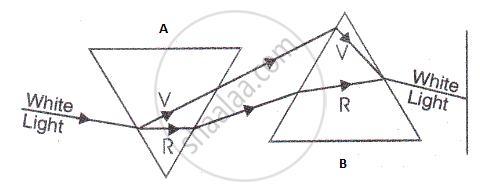
The diagram below shows the path taken by a narrow beam of yellow monochromatic light passing through an equiangular glass prism. If the yellow light is replaced by a narrow beam of white light incident at the same angle, draw another diagram to show the passage of white light through the prism and label it to show the effect of prism on the white light.

The path taken by a narrow beam of yellow monochromatic light travelling through an equiangular glass prism is shown in the figure. If the yellow light is replaced by white light with the same angle of incidence, show the path of white light through the prism using a neat, labelled diagram.
Advertisements
Solution
RELATED QUESTIONS
The path of a ray of light passing through a glass prism is shown below:
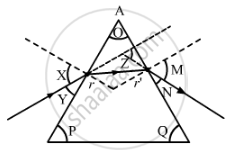
In this diagram, the angle of prism, angle of incidence, angle of emergence and angle of deviation, respectively, have been represented by:
(A) O, Y, Z and N,
(B) P, Y, M and Z,
(C) O, X, M and Z,
(D) P, X, Z and N.
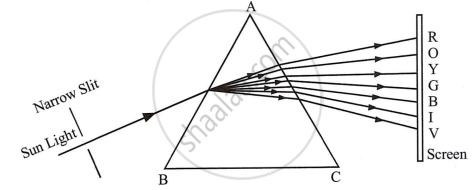
Draw a ray diagram to show the dispersion of white light.
In the figure given alongside, a narrow beam of white light is shown to pass through a triangular glass prism. After passing through the prism, it produces a spectrum YX on the screen.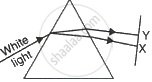
- State the colour seen
- at X, and
- at Y.
- Why do different colours of white light bend through different angles with respect to the incident beam of light?
The property of splitting of white light into its seven constituent colours is known as
In the spectrum of white light by a prism, the colour at the extreme end opposite to the base of prism is ______.
In the following diagram, the correctly marked angles are
(A) All
(B) Only ∠i and ∠A
(C) ∠i, ∠r and ∠A
(D) ∠i, ∠A and ∠D
Complete the ray diagram given below to show the nature of light produced on the screen.
The completed ray diagram is as shown below:
Write the range of wavelength of the visible spectrum.
The splitting of white light into its component colours is called ____________.
Make a rainbow
Try to make your own rainbow. You can try this project in the morning or in the evening. Stand with your back towards the Sun. Take a hosepipe or a water pipe used in the garden. Make a fine spray in front of you. You can see different colours of rainbow in the spray.
