Advertisements
Advertisements
Question
In the spectrum of white light by a prism, the colour at the extreme end opposite to the base of prism is ______.
Options
Violet
Yellow
Red
Blue
Advertisements
Solution
In the spectrum of white light by a prism, the colour at the extreme end opposite to the base of prism is red.
APPEARS IN
RELATED QUESTIONS
A student traces the path of a ray of light through a triangular glass prism for different values of angle of incidence. On analyzing the ray diagrams, which one of the following conclusions is he likely to draw?
(A) The emergent ray is parallel to the incident ray.
(B) The emergent ray bends at an angle to the direction of the incident ray.
(C) The emergent ray and the refracted ray are at right angles to each other.
(D) The emergent ray is perpendicular to the incident ray.
The path of a ray of light passing through a glass prism is shown below:
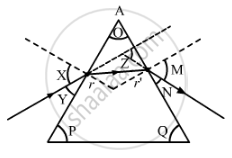
In this diagram, the angle of prism, angle of incidence, angle of emergence and angle of deviation, respectively, have been represented by:
(A) O, Y, Z and N,
(B) P, Y, M and Z,
(C) O, X, M and Z,
(D) P, X, Z and N.
Draw a ray diagram to explain the term angle of deviation.
In the following diagram the correctly marked angles are :

(a) ∠A and ∠e
(b) ∠i, ∠A and ∠D
(c) ∠A ∠r and ∠e
(b) ∠A ∠r and ∠D
In the formation of spectrum of white light by a prism:
which colour is deviated most?
Why do you not see a spectrum of colours when light passes through a flat pane of glass?
A glass prism is able to produce the spectrum when white light passes through it, but a glass slab doesn’t produce any spectrum. Explain why it is so.
What do you understand by spectrum? Name the seven prominent colours in order, as obtained in the spectrum of white light.
Distinguish between an impure spectrum and a pure spectrum.
In the following diagram showing dispersion of white light by a glass prism, the colours 'P' and 'Q’ respectively are:

