Advertisements
Advertisements
Question
Why do the component colours of incident white light split into a spectrum while passing through a glass prism, explain
Advertisements
Solution

The splitting of a beam of white light into its seven constituent colours, when it passes through a glass prism, is called the dispersion of light.
When a beam of white light enters a prism, it gets refracted and splits into its seven constituent colours, viz. violet, indigo, blue, green, yellow, orange, and red. This splitting of the light ray occurs because of the different angles of bending for each colour. Hence, each colour while passing through the prism bends at different angles with respect to the incident beam. This gives rise to the formation of the colour spectrum.
APPEARS IN
RELATED QUESTIONS
State the cause of dispersion of white light
What is spectrum?
Which of the following coloured light has the least speed in glass prism?
(a) violet
(b) yellow
(c) red
(d) green
A ray of light moving from an optically rarer to a denser medium
Which is optically denser: water or air? Give reason
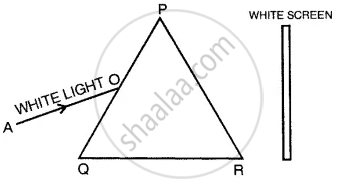
In figure AO is the ray of white light falling on a prism PQR. Complete the diagram till the light emerges out from the prism and falls on the screen.
You are given a disc divided into seven sectors with colours violet, indigo, blue, green, yellow, orange and red in them. What would be its colour when it is rotated rapidly?
What conclusion do you draw about the nature of white light in part (b)?
Which characteristic property of light is responsible for the blue colour of the sky?
Why do we see a rainbow in the sky only after rainfall?
