Advertisements
Advertisements
प्रश्न
Why do the component colours of incident white light split into a spectrum while passing through a glass prism, explain
Advertisements
उत्तर

The splitting of a beam of white light into its seven constituent colours, when it passes through a glass prism, is called the dispersion of light.
When a beam of white light enters a prism, it gets refracted and splits into its seven constituent colours, viz. violet, indigo, blue, green, yellow, orange, and red. This splitting of the light ray occurs because of the different angles of bending for each colour. Hence, each colour while passing through the prism bends at different angles with respect to the incident beam. This gives rise to the formation of the colour spectrum.
APPEARS IN
संबंधित प्रश्न
Describe an activity to show that colours of white light splitted by a glass prism can be recombined to get white light by another identical glass prism. Also draw ray diagram to show the recombination of the spectrum of white light.
- A ray of white light breaks up into its components while passing through a glass prism. Draw a ray diagram to show the path of rays.
- Mark the least deviated colour in your diagram.
- Why do different coloured rays deviate differently in a prism?
What is a rainbow?
How does the speed of light determine the optical density of a medium?
In the spectrum of white light by a prism, the colour at the extreme end opposite to the base of prism is ______.
Complete the ray diagram given below to show the nature of light produced on the screen.
The completed ray diagram is as shown below:
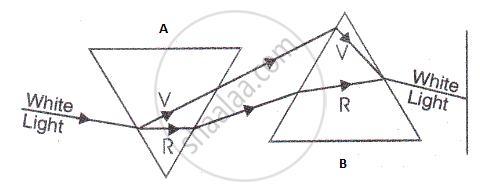
The splitting of white light in to seven colors is called ______.
Say TRUE or FALSE
After passing through a prism, white light splits into a band of seven colours
State the colour which bends:
- The most.
- The least while passing through a glass prism.
A ray of light is incident at 45° on an equilateral prism in the diagram below.

- Name the phenomenon exhibited by the ray of light when it enters and emerges out of the prism.
- State the cause of the above phenomenon mentioned by you.
