English Medium
Academic Year: 2016-2017
Date & Time: 21st March 2017, 12:30 pm
Duration: 3h
Advertisements
Write the molecular formula of first two members of homologous series having functional group – OH
Chapter:
How does Plasmodium reproduce. Is this method sexual or asexual?
Chapter:
Why is a lake considered to be a natural ecosystem?
Chapter:
An object is placed at a distance of 12 cm in front of a concave mirror of radius of curvature 30 cm. List four characteristics of the image formed by the mirror.
Chapter:
How do advantages of exploiting natural resources with short term gains in mind differ from the advantages of managing our resources with a long-term perspective?
Chapter:
Complete the following chemical equations: C2H5OH+O2→
Chapter:
Complete the following chemical equations : C2H5OH`("Conc."H_2SO_4)/(443K)`>
Chapter:
Complete the following chemical equations: CH3COOH+NaHCO3→
Chapter:
The molecular formula of two carbon compounds are C4H8 and C3H8. Which one of the two is most likely to show addition reaction? Justify your answer. Also give the chemical equation to explain the process of addition reaction in this case.
Chapter:
Write the names given to the vertical columns and horizontal rows in the Modern Periodic Table. How does the metallic character of elements vary on moving down a vertical column? How does the size of atomic radius vary on moving left to right in a horizontal row? Give reason in support of your answer in the above two cases.
Chapter:
An element P (atomic number 20) reacts with an element Q (atomic number 17) to form a compound. Answer the following questions giving reason:
Write the position of P and Q in the Modern Periodic Table and the molecular formula of the compound formed when P reacts with Q.
Chapter:
How do Mendel's experiment show that traits are inherited independently?
Chapter: [8] Heredity
Explain with an example for the given, how the following provides evidence in favor of evolution in organisms:
Homologous organs
Chapter:
Explain with an example for the given, how the following provides evidence in favor of evolution in organisms :
Analogous organs
Chapter:
Explain with an example for the given, how the following provides evidence in favor of evolution in organisms :
Fossils
Chapter:
Advertisements
What happens when a Planaria gets cut into two pieces?
Chapter:
What happens when On maturation sporangia of Rhizopus bursts?
Chapter:
What happens when Bryophyllum leaf falls on the wet soil?
Chapter:
List any four steps involved in sexual reproduction .
Chapter:
State the changes that take place in the uterus when Implantation of embryo has occurred
Chapter:
State the changes that take place in the uterus when Female gamete/egg is not fertilised
Chapter:
The image of a candle flame placed at a distance of 30 cm from a mirror is formed on a screen placed in front of the mirror at a distance of 60 cm from its pole. What is the nature of the mirror? Find its focal length. If the height of the flame is 2.4 cm, find the height of its image. State whether the image formed is erect or inverted.
Chapter:
Define the term.
Power of accommodation of the eye.
Chapter:
Explain why the image distance in the eye does not change when we change the distance of an object from the eye?
Chapter:
You have been selected to talk on 'ozone layer and its protection" in the school assembly on 'Environment Day.'
(a) Why should ozone layer be protected to save the environment?
(b) List any two ways that you would stress in your talk to bring in awareness amongst your fellow friends that would also help in protection of ozone layer as well as the environment.
Chapter:
How do Mendel’s experiments show that the traits may be dominant or recessive?
Chapter: [8] Heredity
How do Mendel's experiment show that traits are inherited independently?
Chapter: [8] Heredity
Name the human male reproductive organ that produces sperms and also secretes a hormone. Write the functions of the secreted hormone.
Chapter:
Name the parts of the human female reproductive system where
i. fertilisation takes place
ii. implantation of the fertilised egg occurs
Chapter:
Explain how the embryo gets nourishment inside the mother’s body.
Chapter:
Draw a ray diagram to explain the term angle of deviation.
Chapter: [10] The Human Eye and the Colourful World
Why do the component colours of incident white light split into a spectrum while passing through a glass prism, explain
Chapter: [10] The Human Eye and the Colourful World
What is a rainbow? Draw a labelled diagram to show the formation of a rainbow.
Chapter:
To construct a ray diagram we use two rays which are so chosen that it is easy to know their directions after reflection from the mirror. List two such rays and state the path of these rays after reflection in case of concave mirrors. Use these two rays and draw ray diagram to locate the image of an object placed between pole and focus of a concave mirror.
Chapter:
A concave mirror produces three times magnified image on a screen. If the object is placed 20 cm in front of the mirror, how far is the screen from the object.
Chapter:
Analyse the following observation table showing variation of image distance (v) with object distance (u) in case of a convex lens and answer the questions that follow, without doing any calculations:
| S. No. | Object distance u(cm) | Image distance v(cm) |
| 1 | −90 | +18 |
| 2 | −60 | +20 |
| 3 | −30 | +30 |
| 4 | −20 | +60 |
| 5 | −18 | +90 |
| 6 | −10 | +100 |
(a) What is the focal length of the convex lens? Give reason in support of your answer.
(b) Write the serial number of that observation which is not correct. How did you arrive at this conclusion?
(c) Take an appropriate scale to draw ray diagram for the observation at S. No. 4 and find the approximate value of magnification.
Chapter:
Both soap and detergent are some type of salts. What is the difference between them?
Chapter:
Describe in brief the cleansing action of soap.
Chapter:
Advertisements
The correct sequencing of angle of incidence, angle of emergence, angle of refraction and lateral displacement shown in the following diagram by digits 1, 2, 3 and 4 is:

(a) 2, 4, 1, 3
(b) 2, 1, 4, 3
(c) 1, 2, 4, 3
(d) 2, 1, 3, 4
Chapter: [10] The Human Eye and the Colourful World
In the following diagram the correctly marked angles are :

(a) ∠A and ∠e
(b) ∠i, ∠A and ∠D
(c) ∠A ∠r and ∠e
(b) ∠A ∠r and ∠D
Chapter: [10] The Human Eye and the Colourful World
If you focus the image of a distant object, whose shape is given below, on a screen using a convex lens, the shape of the image of this object on the screen would be:
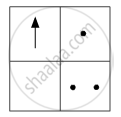
(a)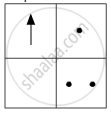
(b)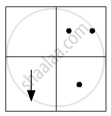
(c)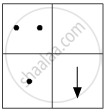
(d)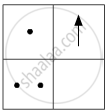
Chapter:
Three students A, B and C focussed a distant building on a screen with the help of a concave mirror. To determine focal length of the concave mirror they measured the distances as given below:
Student A : From mirror to the screen
Student B : From building to the screen
Student C : From building to the mirror
Who measured the focal length correctly ;
(a) Only A
(b) Only B
(c) A and B
(d) B and C
Chapter:
For preparing soap in the laboratory we require an oil and a base. Which of the following combinations of an oil and a base would be best suited for the preparation of soap?
(a) Castor oil and calcium hydroxide
(b) Turpentine oil and sodium hydroxide
(c) Castor oil and sodium hydroxide
(d) Mustard oil and calcium hydroxide
Chapter:
You have four test tubes, A, B, C and D containing sodium carbonate, sodium chloride, lime water and blue litmus solutions respectively. Out of these the material of which test tube/ test tubes would be suitable for the correct test of acetic/ethanoic acid?
(a) only A
(b) A and B
(c) B and C
(d) A and D
Chapter:
A student took four test tubes P, Q, R and S and filled about 8 mL of distilled water in each. After that he dissolved an equal amount of Na2SO4 in P, K2SO4 in Q, CaSO4 in R and MgSO4 in S. On adding an equal amount of soap solution and shaking each test tube well, a good amount of lather will be obtained in the test tubes:
(a) P and Q
(b) P and R
(c) P, Q and S
(d) Q, R and S
Chapter:
Four students A, B, C and D reported the following set of organs to be homologous. Who is correct ?
(A) Wings of a bat and a butterfly
(B) Wings of a pigeon and a bat
(C) Wings of a pigeon and a butterfly
(D) Forelimbs of cow, a duck and a lizard
Chapter:
A student while observing an embryo of a gram seed listed various parts of the embryo as listed below :
Testa, Micropyle, Cotyledon, Tegmen, Plumule, Radicle. On examining the list the teacher commented that only three parts are correct. Select these three correct parts :
(a) Cotyledon, Testa, Plumule
(b) Cotyledon, Plumule, Radicle
(c) Cotyledon, Tegmen, Radicle
(d) Cotyledon, Micropyle, Plumule
Chapter:
Name the type of asexual reproduction in which two individuals are formed from a single parent and the parental identity is lost. Draw the initial and the final stages of this type of reproduction. State the event with which this reproduction starts.
Chapter:
A student places a candle flame at a distance of about 60 cm from a convex lens of focal length 10 cm and focuses the image of the flame on a screen. After that he gradually moves the flame towards the lens and each time focuses the image on the screen.
(a) In which direction-toward or away from the lens, does he move the screen to focus the image?
(b) How does the size of the image change?
(c) How does the intensity of the image change as the flame moves towards the lens?
(d) Approximately for what distance between the flame and the lens, the image formed on the screen is inverted and of the same size?
Chapter:
A gas is liberated immediately with a brisk effervescence, when you add acetic acid to sodium hydrogen carbonate powder in a test tube. Name the gas and describe the test that confirms the identity of the gas.
Chapter:
Other Solutions
Submit Question Paper
Help us maintain new question papers on Shaalaa.com, so we can continue to help studentsonly jpg, png and pdf files
CBSE previous year question papers Class 10 Science with solutions 2016 - 2017
Previous year Question paper for CBSE Class 10 Science-2017 is solved by experts. Solved question papers gives you the chance to check yourself after your mock test.
By referring the question paper Solutions for Science, you can scale your preparation level and work on your weak areas. It will also help the candidates in developing the time-management skills. Practice makes perfect, and there is no better way to practice than to attempt previous year question paper solutions of CBSE Class 10.
How CBSE Class 10 Question Paper solutions Help Students ?
• Question paper solutions for Science will helps students to prepare for exam.
• Question paper with answer will boost students confidence in exam time and also give you an idea About the important questions and topics to be prepared for the board exam.
• For finding solution of question papers no need to refer so multiple sources like textbook or guides.
