Advertisements
Advertisements
प्रश्न
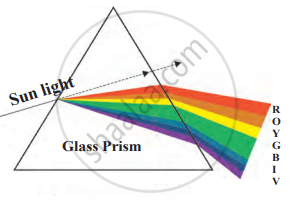
Why do the component colours of incident white light split into a spectrum while passing through a glass prism, explain
Advertisements
उत्तर

The splitting of a beam of white light into its seven constituent colours, when it passes through a glass prism, is called the dispersion of light.
When a beam of white light enters a prism, it gets refracted and splits into its seven constituent colours, viz. violet, indigo, blue, green, yellow, orange, and red. This splitting of the light ray occurs because of the different angles of bending for each colour. Hence, each colour while passing through the prism bends at different angles with respect to the incident beam. This gives rise to the formation of the colour spectrum.
APPEARS IN
संबंधित प्रश्न
State the cause of dispersion of white light passing through a glass prism. How did Newton show that white light of sun contains seven colours using two identical glass prisms. Draw a ray diagram to show the path of light when two identical glass prisms are arranged together in inverted position with respect to each other and a narrow beam of white light is allowed to fall obliquely on one of the focus of the first prism.
- A ray of white light breaks up into its components while passing through a glass prism. Draw a ray diagram to show the path of rays.
- Mark the least deviated colour in your diagram.
- Why do different coloured rays deviate differently in a prism?
Draw a diagram to show how white light can be dispersed into a spectrum by using a glass prism. Mark the various colours of the spectrum.
Which of the following colour of white light is least deviated by the prism?
(a) green
(b) violet
(c) indigo
(d) yellow
The coloured light having the maximum speed in glass prism is ______.
What do you understand by the term spectrum? Name the various colours present in the spectrum of sunlight.
The wavelengths of violet and red light are 4000 Å and 8000 Å respectively. Which of the two has the higher frequency?
How can the presence of ultraviolet radiation be detected?
Observe the given figure and answer the following questions.
- Which colour light rays bend most?
- Which colour light rays bend least.
- What is the wavelength of violet light rays?
A prism of refractive index `sqrt2` and refracting angle A produces minimum deviation δm of a ray on one face at an angle of incidence 45°, The values of A and δm are, respectively ______.
