Advertisements
Advertisements
Question
Why do you not see a spectrum of colours when light passes through a flat pane of glass?
Advertisements
Solution
When light passes through a flat pane of glass, the refracted light emerges out of the glass pane without any deviation because a glass pane has two sides that are parallel to each other. As the emergent light does not deviate from the original direction by any angle, we do not see the different colours of the light separated out in the form of a spectrum. Therefore, in order to view a spectrum of colours, the incident rays have to fall on an object whose surfaces are not parallel, such as a glass prism (triangular shape).
APPEARS IN
RELATED QUESTIONS
State the cause of dispersion of white light passing through a glass prism. How did Newton show that white light of sun contains seven colours using two identical glass prisms. Draw a ray diagram to show the path of light when two identical glass prisms are arranged together in inverted position with respect to each other and a narrow beam of white light is allowed to fall obliquely on one of the focus of the first prism.
In the formation of spectrum of white light by a prism:
- which colour is deviated least?
- which colour is deviated most?
When a ray of light enters a prism, it bends ______ the normal; as it leaves the prism, it bends ______ the normal.
Name the process which is involved in the formation of a rainbow.
What are the seven colours seen in a rainbow?
Out of the following, the colour of light having the maximum wavelength is:
(a) violet
(b) indigo
(c) green
(d) orange
The splitting of white light into its constituent colours is called .............
A ray of light moving from an optically rarer to a denser medium
Define the term dispersion of light.
While performing the experiment to trace the path of a ray of light passing through a glass prism, four students marked the incident ray and the emergent ray in their diagrams in the manner shown below. 
(A) I
(B) II
(C) III
(D) IV
The phenomenon of splitting of light into its component colours is ___________ .
What is the cause of the dispersion of white light through a glass prism? Draw a ray diagram to show the path of light when two identical glass prisms are arranged together in an inverted position with respect to each other and a narrow beam of white light is allowed to fall obliquely on one of the faces of the prisms.
Write the range of wavelength of the visible spectrum.
Observe the given figure and write appropriate phenomenon of light in the box.
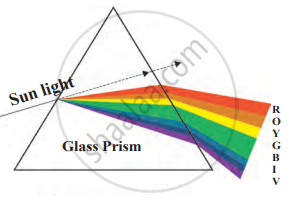
The sunlight can be split into its constituent colors using ______.
Say TRUE or FALSE
After passing through a prism, white light splits into a band of seven colours
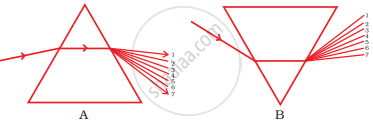
State the correct sequence (1-7) of colours in the spectrum formed by the prisms A and B, shown in the following figure.
A prism of refractive index `sqrt2` and refracting angle A produces minimum deviation δm of a ray on one face at an angle of incidence 45°, The values of A and δm are, respectively ______.
