Advertisements
Advertisements
प्रश्न
Why do you not see a spectrum of colours when light passes through a flat pane of glass?
Advertisements
उत्तर
When light passes through a flat pane of glass, the refracted light emerges out of the glass pane without any deviation because a glass pane has two sides that are parallel to each other. As the emergent light does not deviate from the original direction by any angle, we do not see the different colours of the light separated out in the form of a spectrum. Therefore, in order to view a spectrum of colours, the incident rays have to fall on an object whose surfaces are not parallel, such as a glass prism (triangular shape).
APPEARS IN
संबंधित प्रश्न
Draw a ray diagram to show the dispersion of white light.
- A ray of white light breaks up into its components while passing through a glass prism. Draw a ray diagram to show the path of rays.
- Mark the least deviated colour in your diagram.
- Why do different coloured rays deviate differently in a prism?
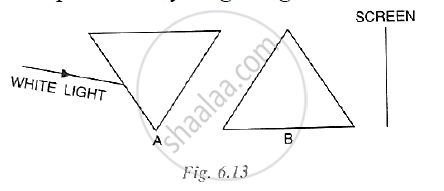
What will happen if another similar glass prism is placed upside down behind the first prism?
Draw a diagram to show how white light can be dispersed into a spectrum by using a glass prism. Mark the various colours of the spectrum.
Which is refracted most by a prism : red light or violet light? Explain why?
A beam of white light is shone onto a glass prism. The light cannot be:
(a) deviated
(b) dispersed
(c) focused
(d) refracted
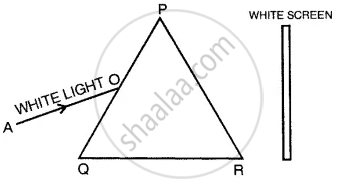
In figure AO is the ray of white light falling on a prism PQR. Complete the diagram till the light emerges out from the prism and falls on the screen.
Complete the ray diagram given below to show the nature of light produced on the screen.
The frequency range of visible light is from 3.75 × 10¹⁴ Hz to 7.5 × 10¹⁴ Hz. Calculate its wavelength range. Take speed of light = 3 × 10⁸ m/s.
While performing the experiment to trace the path of a ray of light passing through a glass prism, four students marked the incident ray and the emergent ray in their diagrams in the manner shown below. 
(A) I
(B) II
(C) III
(D) IV
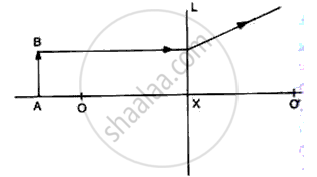
Refer to fig
(i) Name the lens L.
(ii) What are the points O, O' called?
(iii) Complete the diagram to form the image of the object AB.
(iv) Write three characteristics of the image.
The wavelength range of white light is ______.
Write three conditions necessary to obtain a pure spectrum on a screen. Name the instrument in which the conditions stated by you are fulfilled.
Distinguish between an impure spectrum and a pure spectrum.
Match the Columns:
| Column ‘A’ | Column ‘B’ |
| The wavelength of red light | (a) 600 nm |
| (b) 700 nm | |
| (c) 500 nm |
When white light enters a glass prism from the air, the angle of deviation is least for ____________.
The phenomena of light involved in the formation of rainbow are ______.
The periscope is an optical device with a polished surface that reflects the light falling on it.
______ colour is deviated the least in the spectrum of white light obtained with a glass prism.
State the colour which bends:
- The most.
- The least while passing through a glass prism.
