Advertisements
Advertisements
प्रश्न
While performing the experiment to trace the path of a ray of light passing through a glass prism, four students marked the incident ray and the emergent ray in their diagrams in the manner shown below. 
(A) I
(B) II
(C) III
(D) IV
Advertisements
उत्तर
(C)
When light goes from rarer medium to denser medium; it bends towards the normal and vice-versa. This condition is fulfilled in figure (III).
APPEARS IN
संबंधित प्रश्न
The colour of white light which suffers the maximum bending (or maximum refraction) on passing through a glass prism is:
(a) yellow
(b) orange
(c) red
(d) violet
The seven colours in the spectrum of sunlight in order, are represented as :
How does the speed of light determine the optical density of a medium?
When we place a glass prism in the path of a narrow beam of white light a spectrum is obtained. What happens when a second identical prism is placed in an inverted position with respect to the first prism? Draw a labelled ray diagram to illustrate it.
State two properties of ultraviolet radiation which differ from visible light.
Distinguish between an impure spectrum and a pure spectrum.
Observe the given figure and write appropriate phenomenon of light in the box.
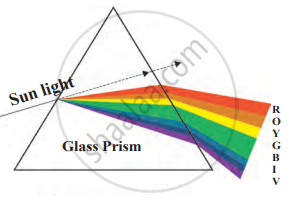
Observe the given figure and answer the following questions.
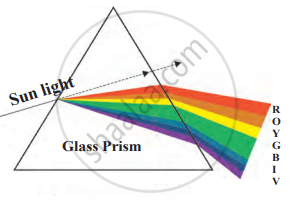
- Which colour light rays bend most?
- Which colour light rays bend least.
- What is the wavelength of violet light rays?
Assertion: We can see the rainbow in the sky when the rain starts falling after a spell of bright sunlight.
Reason: The rainbow is formed due to the dispersion of light.
What is a rainbow?
