Advertisements
Advertisements
Question
While performing the experiment to trace the path of a ray of light passing through a glass prism, four students marked the incident ray and the emergent ray in their diagrams in the manner shown below. 
(A) I
(B) II
(C) III
(D) IV
Advertisements
Solution
(C)
When light goes from rarer medium to denser medium; it bends towards the normal and vice-versa. This condition is fulfilled in figure (III).
APPEARS IN
RELATED QUESTIONS
Draw a ray diagram to show the dispersion of white light.
In the formation of spectrum of white light by a prism:
- which colour is deviated least?
- which colour is deviated most?
A ray of white light falls on a prism. Draw a ray diagram to show that the prism disperses the white light.
A ray of white light is passed through a glass prism and a spectrum is obtained on a screen.
- Name the seven colours of the spectrum in order.
- Do the colours have the same width in the spectrum?
- Which of the colour of the spectrum of white light deviates (i) the most, (ii) the least?
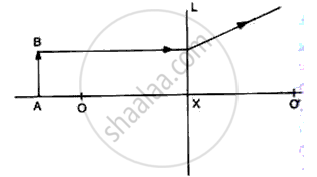
Refer to fig
(i) Name the lens L.
(ii) What are the points O, O' called?
(iii) Complete the diagram to form the image of the object AB.
(iv) Write three characteristics of the image.
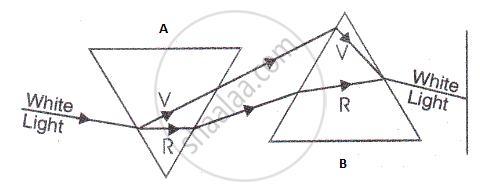
Complete the ray diagram given below to show the nature of light produced on the screen.
The completed ray diagram is as shown below:
The splitting of white light into its component colours is called ____________.
In dispersion, the color of light that will bend more is ______.
______ colour is deviated the least in the spectrum of white light obtained with a glass prism.
The dispersive powers of flint glass and crown glass are 0.053 and 0.034, respectively and their mean refractive indices are 1.68 and 1.53 for white light. Calculate the angle of the flint glass prism required to form an achromatic combination with a crown glass prism of refracting angle 4°:
