Advertisements
Advertisements
प्रश्न
While performing the experiment to trace the path of a ray of light passing through a glass prism, four students marked the incident ray and the emergent ray in their diagrams in the manner shown below. 
(A) I
(B) II
(C) III
(D) IV
Advertisements
उत्तर
(C)
When light goes from rarer medium to denser medium; it bends towards the normal and vice-versa. This condition is fulfilled in figure (III).
APPEARS IN
संबंधित प्रश्न
Define the term dispersion of white light.
What will happen if another similar glass prism is placed upside down behind the first prism?
Draw a diagram to show the refraction of light through a glass prism. On this diagram, mark
(i) incident ray
(ii) emergent ray, and
(iii) angle of deviation.
When we place a glass prism in the path of a narrow beam of white light a spectrum is obtained. What happens when a second identical prism is placed in an inverted position with respect to the first prism? Draw a labelled ray diagram to illustrate it.
The wavelengths of violet and red light are 4000 Å and 8000 Å respectively. Which of the two has the higher frequency?
Draw a neat and labelled diagram for dispersion of light.
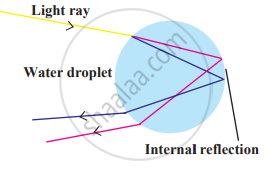
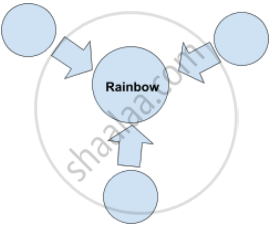
Rainbow is a beautiful natural phenomenon. It is the combined effect of a natural three processes together produced by light. Write it into the circle.
The dispersive powers of flint glass and crown glass are 0.053 and 0.034, respectively and their mean refractive indices are 1.68 and 1.53 for white light. Calculate the angle of the flint glass prism required to form an achromatic combination with a crown glass prism of refracting angle 4°:
Make a rainbow
Try to make your own rainbow. You can try this project in the morning or in the evening. Stand with your back towards the Sun. Take a hosepipe or a water pipe used in the garden. Make a fine spray in front of you. You can see different colours of rainbow in the spray.
