Advertisements
Advertisements
प्रश्न
What will happen if another similar glass prism is placed upside down behind the first prism?
Advertisements
उत्तर
If a second, similar glass prism is placed upside down behind the first prism, recombination of seven colours takes place and a patch of ordinary white light is obtained on a screen placed behind the second prism. The recombination of colours took place because the second prism was placed upside down, because of which the refraction produced by the second prism was equal and opposite to the refraction produced by the first prism.
APPEARS IN
संबंधित प्रश्न
A narrow beam PQ of white light is passing through a glass prism ABC as shown in the diagram.

Trace it on your answer sheet and show the path of the emergent beam as observed on the screen DE.
(i) Write the name and cause of the phenomenon observed.
(ii) Where else in nature is this phenomenon observed?
(iii) Based on this observation, state the conclusion which can be drawn about the constituents of white light.
In the following ray diagram the correctly marked angle are:

(a) ∠i and ∠e
(b) ∠A and ∠D
(c) ∠i, ∠e and ∠D
(d) ∠r, ∠A and ∠D
As light rays pass from air into a glass prism, are they refracted towards or away from the normal?
What is spectrum?
How could you show that the colours of the spectrum combine to give white light?
Which of the following colour of white light is least deviated by the prism?
(a) green
(b) violet
(c) indigo
(d) yellow
Why do you not see a spectrum of colours when light passes through a flat pane of glass?
What do you understand by the term spectrum? Name the various colours present in the spectrum of sunlight.
Explain the cause of dispersion of white light through a prism.
Explain briefly, with the help of a neat labelled diagram, how white light gets dispersed by a prism. On which surface of a prism, there is both dispersion and deviation of light, and on which surface of the prism, there is only deviation of light ?
In the spectrum of white light by a prism, the colour at the extreme end opposite to the base of prism is ______.
An object AB is placed in front of a convex lens as shown in fig. 4. Complete the ray diagram and obtain the image formed and state the nature of the image.
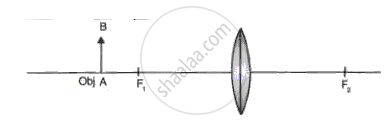
Answer the following:
What do you mean by dispersion? Name the different colours of light in the proper sequence in the spectrum of light.
What is the cause of the dispersion of white light through a glass prism? Draw a ray diagram to show the path of light when two identical glass prisms are arranged together in an inverted position with respect to each other and a narrow beam of white light is allowed to fall obliquely on one of the faces of the prisms.
A student has to trace the path of a ray of light through a glass prism. List four precautions he should observe for better results.
Write the range of wavelength of the ultraviolet spectrum.
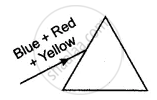
In the figure, a beam of light consisting of three colours blue, red, and yellow is incident on a prism and on a rectangular glass block respectively. Complete the diagram by drawings of the refracted and emergent rays.
Observe the given figure and write appropriate phenomenon of light in the box.
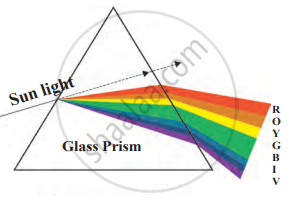
What is dispersion? Explain in detail.
What is a rainbow?
