Advertisements
Advertisements
प्रश्न
What happens when a ray of ordinary light is passed through a triangular glass prism?
Advertisements
उत्तर
When a ray of ordinary light is passed through a triangular glass prism, the light splits into a spectrum of seven colours. This splitting of light into its constituent colours is called dispersion of light. The role of the prism is to separate the seven colours of the white light.
APPEARS IN
संबंधित प्रश्न
Study the following ray diagram:
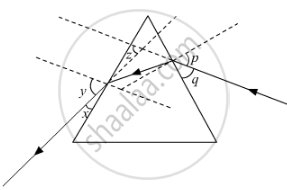
In this diagram, the angle of incidence, the angle of emergence and the angle of deviation respectively have been represented by
(A) y, p, z
(B) x, q, z
(C) p, y, z
(D) p, z, y
Draw a ray diagram to show the dispersion of white light.
- A ray of white light breaks up into its components while passing through a glass prism. Draw a ray diagram to show the path of rays.
- Mark the least deviated colour in your diagram.
- Why do different coloured rays deviate differently in a prism?
As light rays pass from air into a glass prism, are they refracted towards or away from the normal?
In the formation of spectrum of white light by a prism:
- which colour is deviated least?
- which colour is deviated most?
What is spectrum?
The coloured light having the maximum speed in glass prism is ______.
When white light passes through a prism, it ............
An object AB is placed in front of a convex lens as shown in fig. 4. Complete the ray diagram and obtain the image formed and state the nature of the image.
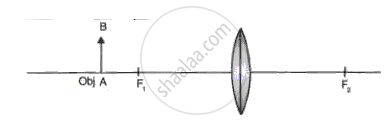
What is the cause of the dispersion of white light through a glass prism? Draw a ray diagram to show the path of light when two identical glass prisms are arranged together in an inverted position with respect to each other and a narrow beam of white light is allowed to fall obliquely on one of the faces of the prisms.
Which characteristic property of light is responsible for the blue colour of the sky?
Write the range of wavelength of the visible spectrum.
In the figure, a beam of light consisting of three colours blue, red, and yellow is incident on a prism and on a rectangular glass block respectively. Complete the diagram by drawings of the refracted and emergent rays.
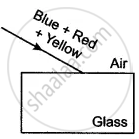
Match the Columns:
| Column ‘A’ | Column ‘B’ |
| The wavelength of red light | (a) 600 nm |
| (b) 700 nm | |
| (c) 500 nm |
The periscope is an optical device with a polished surface that reflects the light falling on it.
Curved mirrors have surfaces that are spherical, cylindrical, parabolic, and ellipsoid.
Assertion: We can see the rainbow in the sky when the rain starts falling after a spell of bright sunlight.
Reason: The rainbow is formed due to the dispersion of light.
During dispersion of white light by prism placed in air, for a particular value of angle of prism,
______ colour is deviated the least in the spectrum of white light obtained with a glass prism.
