Advertisements
Advertisements
प्रश्न
Advertisements
उत्तर
संबंधित प्रश्न
A student is observing a diagram showing the path of a ray of light passing through a glass prism. He would find that for all angles of incidence the ray of light bends:
Draw a ray diagram to show the dispersion of white light.
As light rays pass from air into a glass prism, are they refracted towards or away from the normal?
The speed of light in air or vacuum is
Which is optically denser: water or air? Give reason
What conclusion do you draw about the nature of white light in part (b)?
State two uses of ultraviolet radiation.
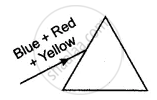
In the figure, a beam of light consisting of three colours blue, red, and yellow is incident on a prism and on a rectangular glass block respectively. Complete the diagram by drawings of the refracted and emergent rays.
Draw a neat and labelled diagram for dispersion of light.
When white light enters a glass prism from the air, the angle of deviation is least for ____________.
