Advertisements
Advertisements
प्रश्न
How does the deviation produced by a triangular prism depend on the colour (or wavelength) of light incident on it?
Advertisements
उत्तर १
Light of different colours have different speeds in a medium.
Therefore, the refractive index of glass (the material of prism) is different for different colours of light and the deviation caused by a prism is different for different colours of light.
Violet is deviated the most because in glass, speed of violet is least.
Red is deviated the least because in glass, speed of red is most.
उत्तर २
Because different colours have different wavelengths in the medium, the deviation that a prism produces depends on the colour (or wavelengths) of the light that impinges on it. Consequently, for various colours of light, the refractive index of glass (the prism's substance) differs, and the deviation brought about by the prism varies accordingly.
संबंधित प्रश्न
Why is the colour red used as a sign of danger?
Name three factors on which the deviation produced by a prism depends and state how does it depend on the factors stated by you.
How does the deviation produced by a triangular prism depend on the colours (or wavelengths) of light incident on it?
Which colour of white light travels fastest in glass?
In following figure shows a thin beam of white light from a source S striking on one face of a prism.
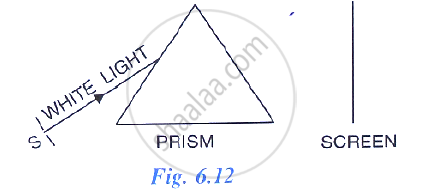
Complete the diagram to show effect of prism on the beam and to show what is seen on the screen.
In following diagram shows a thin beam of white light from a source S striking on one face of a prism.
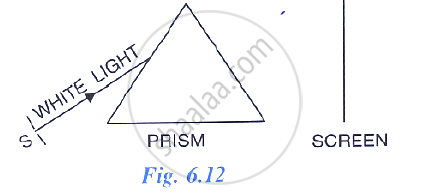
A slit is placed in between the prism and the screen to pass only the light of green colour. What will you then observe on the screen?
In following diagram shows a thin beam of white light from a source S striking on one face of a prism.
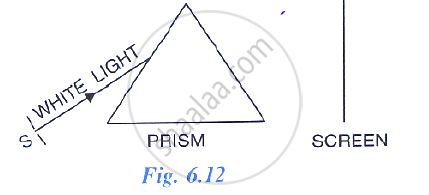
What conclusion do you draw from the observation in part (b) above?
What is understood by the term dispersion of light? What is its cause?
Name the radiation of a wavelength longer than 8 × 10⁻⁷ m.
Which colour of white light travels slowest, in glass?
