Advertisements
Advertisements
प्रश्न
In following diagram shows a thin beam of white light from a source S striking on one face of a prism.
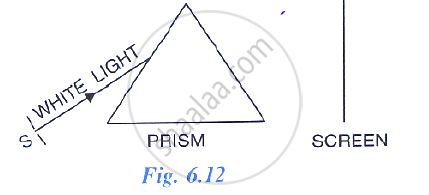
What conclusion do you draw from the observation in part (b) above?
Advertisements
उत्तर
From the observation, we conclude that prism itself produces no colour.
संबंधित प्रश्न
Which colour of white light travels fastest in glass?
If a monochromatic beam of light undergoes minimum deviation through an equiangular prism, how does the beam pass through the prism, with respect to its base?
(i) Draw a diagram to show the splitting of white light by a prism into its constituent colour.
(ii) Draw another diagram to show how the colours of spectrum of white light can be combined
to give the effect of white light.
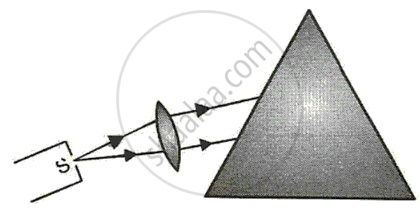
Fig shows part of the arrangement for obtaining pure spectrum.
(a) Complete thediagram and show how to obtain a pure spectrum.
(b) What are the conditions necessary for obtaining a pure spectrum?
Light of different colours is deviated through different angles by a prism. Explain the reason.
A prism causes dispersion of white light while a rectangular glass block does not. Explain.
Which colour of white light travels slowest, in glass?
Write the approximate wavelength for red light.
The wavelengths for the light of red and blue colours are nearly 7·8 × 10-7 m and 4·8 × 10-7 m respectively.
Which colour has greater speed in glass?
