Advertisements
Advertisements
प्रश्न
If a monochromatic beam of light undergoes minimum deviation through an equiangular prism, how does the beam pass through the prism, with respect to its base?
Advertisements
उत्तर
If a monochromatic beam of light undergoes minimum deviation through an equi-angular prism,
then the beam passes parallel to the base of prism.
संबंधित प्रश्न
Why is the colour red used as a sign of danger?
Name three factors on which the deviation produced by a prism depends and state how does it depend on the factors stated by you.
How does the deviation produced by a triangular prism depend on the colours (or wavelengths) of light incident on it?
In following diagram shows a thin beam of white light from a source S striking on one face of a prism.
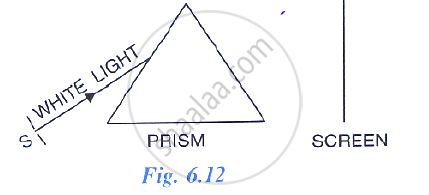
What conclusion do you draw from the observation in part (b) above?
Draw another diagram to show how the colours of spectrum of white light can be combined to give the effect of white light.
Give a reason, why the violet colour of white light deviated most and red colour of white light deviated least.
Explain, why quartz prism is required for obtaining the spectrum of ultra-violet light?
Draw a neat diagram to show the arrangement you would use to project a pure spectrum of white light on a screen.
The wavelengths for the light of red and blue colours are nearly 7·8 × 10-7 m and 4·8 × 10-7 m respectively.
Which colour has greater speed in glass?
