Advertisements
Advertisements
Question
If a monochromatic beam of light undergoes minimum deviation through an equiangular prism, how does the beam pass through the prism, with respect to its base?
Advertisements
Solution
If a monochromatic beam of light undergoes minimum deviation through an equi-angular prism,
then the beam passes parallel to the base of prism.
RELATED QUESTIONS
Name three factors on which the deviation produced by a prism depends and state how does it depend on the factors stated by you.
Which colour of white light travels fastest in glass?
In following figure shows a thin beam of white light from a source S striking on one face of a prism.
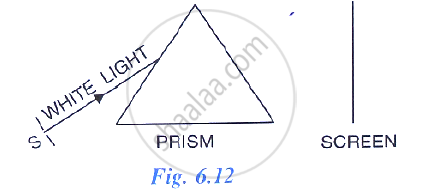
Complete the diagram to show effect of prism on the beam and to show what is seen on the screen.
In following diagram shows a thin beam of white light from a source S striking on one face of a prism.
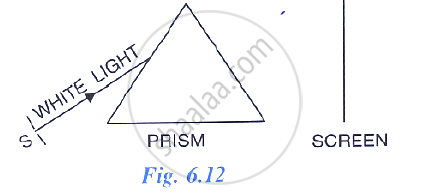
A slit is placed in between the prism and the screen to pass only the light of green colour. What will you then observe on the screen?
Write the approximate wavelengths for blue.
Give a reason, why the violet colour of white light deviated most and red colour of white light deviated least.
What is understood by the term dispersion of light? What is its cause?
Comment on the statement: ‘When any ray of white light is incident on a glass prism, it simply disperses it into its seven constituent colours.
The wavelengths for the light of red and blue colours are nearly 7·8 × 10-7 m and 4·8 × 10-7 m respectively.
Which colour has greater speed in glass?
