Advertisements
Advertisements
Question
Advertisements
Solution
RELATED QUESTIONS
Why do the component colours of incident white light split into a spectrum while passing through a glass prism, explain
State the speed of light in (a) air, (b) water, and (c) glass
What do you understand by the term spectrum? Name the various colours present in the spectrum of sunlight.
You are given a disc divided into seven sectors with colours violet, indigo, blue, green, yellow, orange and red in them. What would be its colour when it is rotated rapidly?
What do you understand by the term spectrum?
A ray of white light is passed through a glass prism and a spectrum is obtained on a screen.
- Name the seven colours of the spectrum in order.
- Do the colours have the same width in the spectrum?
- Which of the colour of the spectrum of white light deviates (i) the most, (ii) the least?
Draw a labeled ray diagram to illustrate the dispersion of a narrow beam of white light when it passes through a glass prism.
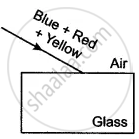
In the figure, a beam of light consisting of three colours blue, red, and yellow is incident on a prism and on a rectangular glass block respectively. Complete the diagram by drawings of the refracted and emergent rays.
Why do we see a rainbow in the sky only after rainfall?
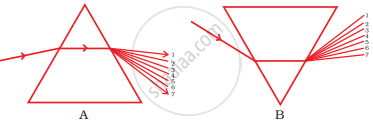
State the correct sequence (1-7) of colours in the spectrum formed by the prisms A and B, shown in the following figure.