Advertisements
Advertisements
Question
After tracing the path of a ray of light through a glass prism a student marked the angle of incidence (∠i), angle of refraction (∠r) angle of emergence (∠e) and the angle of deviation (∠D) as shown in the diagram. The correctly marked angles are :

(A) ∠i and ∠r
(B) ∠i and ∠e
(C) ∠i, ∠e and ∠D
(D) ∠i, ∠r and ∠e
Advertisements
Solution
In the given diagram, the angle of incidence (∠i) and the angle of emergence (∠e) have been correctly marked.
Hence, the correct option is B.
Disclaimer: In the question paper the angle of emergence ∠e is drawn incorrectly as it is shown between the normal and the surface of the prism.
APPEARS IN
RELATED QUESTIONS
In the figure given alongside, a narrow beam of white light is shown to pass through a triangular glass prism. After passing through the prism, it produces a spectrum YX on the screen.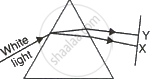
- State the colour seen
- at X, and
- at Y.
- Why do different colours of white light bend through different angles with respect to the incident beam of light?
What do you understand by the term spectrum? Name the various colours present in the spectrum of sunlight.
Explain the cause of dispersion of white light through a prism.
When a white light ray falls on a prism, the ray at its first surface suffers ______.
The frequency range of visible light is from 3.75 × 10¹⁴ Hz to 7.5 × 10¹⁴ Hz. Calculate its wavelength range. Take speed of light = 3 × 10⁸ m/s.
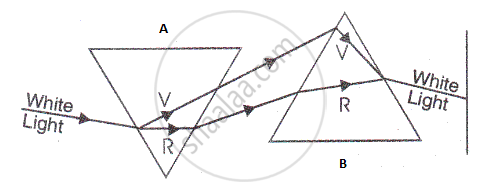
Complete the ray diagram given below to show the nature of light produced on the screen.
The completed ray diagram is as shown below:
A wave has wavelength 50Å of name the wave.
Differentiate between a glass slab and a glass prism.
Match the Columns:
| Column ‘A’ | Column ‘B’ |
| The wavelength of red light | (a) 600 nm |
| (b) 700 nm | |
| (c) 500 nm |
What is dispersion? Explain in detail.
