Advertisements
Advertisements
Question
Make the correct choice for each of the following:
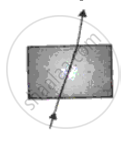
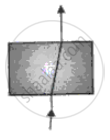
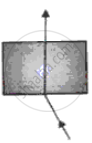
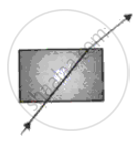
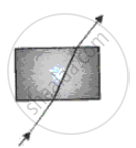
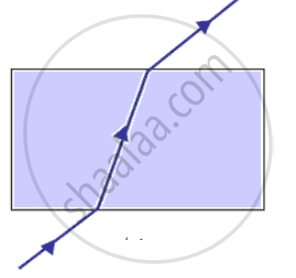
Which one of the following Fig correctly shows the path of the ray through the glass block?
Options
Advertisements
Solution
APPEARS IN
RELATED QUESTIONS
Draw a ray diagram to show the dispersion of white light.
In the formation of spectrum of white light by a prism:
- which colour is deviated least?
- which colour is deviated most?
What do you understand by the term spectrum? Name the various colours present in the spectrum of sunlight.
- A beam of monochromatic light undergoes minimum deviation through an equiangular prism, how does the beam pass through the prism, with respect to its base?
- If white light is used in the same way as in part (a) above, what change do you expect in the emergent beam?
- What conclusion do you draw about the nature of white light in part (b)?
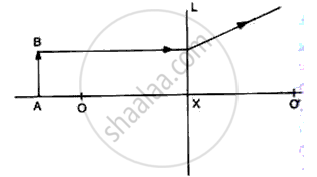
Refer to fig
(i) Name the lens L.
(ii) What are the points O, O' called?
(iii) Complete the diagram to form the image of the object AB.
(iv) Write three characteristics of the image.
An object is placed in front of a converging lens and in front of a diverging lens as in fig.
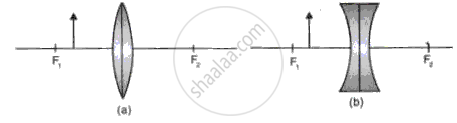
(a)Complete the ray diagram to obtain an image.
(b)Compare the nature of image formed by both the lenses in the above case.
Which characteristic property of light is responsible for the blue colour of the sky?
Write the range of wavelength of the ultraviolet spectrum.
The periscope is an optical device with a polished surface that reflects the light falling on it.
