Advertisements
Advertisements
Question
An object is placed in front of a converging lens and in front of a diverging lens as in fig.
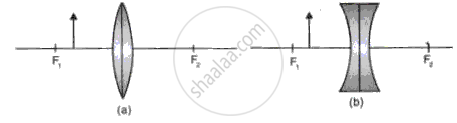
(a)Complete the ray diagram to obtain an image.
(b)Compare the nature of image formed by both the lenses in the above case.
Advertisements
Solution
(a)

(b) In both the cases the image formed is virtual, upright and on the same side of the lens but the image formed by a convex lens is magnified and that formed by a concave lens is diminished.
APPEARS IN
RELATED QUESTIONS
In the figure given alongside, a narrow beam of white light is shown to pass through a triangular glass prism. After passing through the prism, it produces a spectrum YX on the screen.
Why do different colours of white light bend through different angles with respect to the incident beam of light?
Why do you not see a spectrum of colours when light passes through a flat pane of glass?
- A beam of monochromatic light undergoes minimum deviation through an equiangular prism, how does the beam pass through the prism, with respect to its base?
- If white light is used in the same way as in part (a) above, what change do you expect in the emergent beam?
- What conclusion do you draw about the nature of white light in part (b)?
In the spectrum of white light by a prism, the colour at the extreme end opposite to the base of prism is ______.
A wave has wavelength 50Å of State its one use.
How can the presence of ultraviolet radiation be detected?
Which one of the following is involved for the formation of rainbow in the sky?
In dispersion, the color of light that will bend more is ______.
Assertion: We can see the rainbow in the sky when the rain starts falling after a spell of bright sunlight.
Reason: The rainbow is formed due to the dispersion of light.
dispersive power of crown glass? Given that µv = 1.5230, µr = 1.5145
