Advertisements
Advertisements
Question
- A beam of monochromatic light undergoes minimum deviation through an equiangular prism, how does the beam pass through the prism, with respect to its base?
- If white light is used in the same way as in part (a) above, what change do you expect in the emergent beam?
- What conclusion do you draw about the nature of white light in part (b)?
Advertisements
Solution
- The beam of light pass parallel to the base.
- White light splits into its constituent colours i.e., spectrum is formed.
- White light is Polychromatic.
APPEARS IN
RELATED QUESTIONS
What is spectrum?
While performing the experiment to trace the path of a ray of light passing through a glass prism, four students marked the incident ray and the emergent ray in their diagrams in the manner shown below. 
(A) I
(B) II
(C) III
(D) IV
Write the range of wavelength of the visible spectrum.
What is dispersion? Explain in detail.
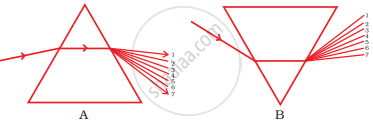
State the correct sequence (1-7) of colours in the spectrum formed by the prisms A and B, shown in the following figure.
Which one of the following is involved for the formation of rainbow in the sky?
The periscope is an optical device with a polished surface that reflects the light falling on it.
______ colour is deviated the least in the spectrum of white light obtained with a glass prism.
Make a rainbow
Try to make your own rainbow. You can try this project in the morning or in the evening. Stand with your back towards the Sun. Take a hosepipe or a water pipe used in the garden. Make a fine spray in front of you. You can see different colours of rainbow in the spray.
