Advertisements
Advertisements
Question
The process of separation of light into its component colours while passing through a medium is called _______.
Options
reflection of light
refraction of light
dispersion of light
absorption of light
Advertisements
Solution
The process of separation of light into its component colours while passing through a medium is called dispersion of light.
APPEARS IN
RELATED QUESTIONS
In the following diagram, the path of a ray of light passing through a glass prism is shown:
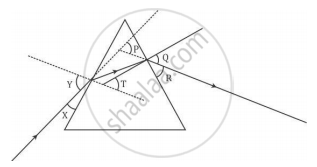
In this diagram the angle of incidence, the angle of emergence and the angle of deviation respectively are (select the correct option):
(A) X, R and T
(B) Y, Q and T
(C) X, Q and P
(D) Y, Q and P
Study the following ray diagram:
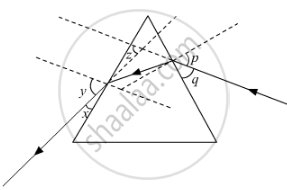
In this diagram, the angle of incidence, the angle of emergence and the angle of deviation respectively have been represented by
(A) y, p, z
(B) x, q, z
(C) p, y, z
(D) p, z, y
Define the term dispersion of white light.
Draw a ray diagram to show the dispersion of white light.
- A ray of white light breaks up into its components while passing through a glass prism. Draw a ray diagram to show the path of rays.
- Mark the least deviated colour in your diagram.
- Why do different coloured rays deviate differently in a prism?
As light rays emerge from a glass prism into air, are they refracted towards or away from the normal?
In the formation of spectrum of white light by a prism:
- which colour is deviated least?
- which colour is deviated most?
The coloured light having the maximum speed in glass prism is ______.
How does the speed of light determine the optical density of a medium?
Explain briefly, with the help of a neat labelled diagram, how white light gets dispersed by a prism. On which surface of a prism, there is both dispersion and deviation of light, and on which surface of the prism, there is only deviation of light ?
What conclusion do you draw about the nature of white light in part (b)?
When a white light ray falls on a prism, the ray at its first surface suffers ______.
An object AB is placed in front of a convex lens as shown in fig. 4. Complete the ray diagram and obtain the image formed and state the nature of the image.
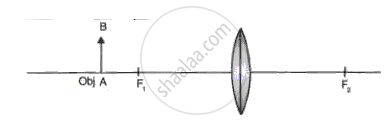
Make the correct choice for each of the following:
Which one of the following Fig correctly shows the path of the ray through the glass block?
Write three conditions necessary to obtain a pure spectrum on a screen. Name the instrument in which the conditions stated by you are fulfilled.
Distinguish between an impure spectrum and a pure spectrum.
The phenomena of light involved in the formation of rainbow are ______.
The splitting of white light into its component colours is called ____________.
When sunlight passes through water droplets in the atmosphere it gets dispersed into its constituent colours forming a rainbow. A similar phenomenon is observed when white light passes through a prism.
Which colour will show the maximum angle of deviation and which colour will show the minimum angle of deviation?
