Advertisements
Advertisements
Questions
The phenomena of light involved in the formation of rainbow are ______.
Which of the following phenomena of light are involved in the formation of a rainbow?
Options
Reflection, refraction and dispersion
Refraction, dispersion and total internal reflection
Refraction, dispersion and internal reflection
Dispersion, scattering and total internal reflection
Advertisements
Solution
Refraction, dispersion and internal reflection
Explanation -
A rainbow is a natural spectrum of seven colours appearing in the sky after a rain shower. It is caused by dispersion of sunlight by tiny water droplets, present in the atmosphere. The water droplets act like small prisms. They refract and disperse the incident sunlight, then reflect it internally, and finally refract it again when it comes out of the raindrop.
APPEARS IN
RELATED QUESTIONS
Why do the component colours of incident white light split into a spectrum while passing through a glass prism, explain
Draw a ray diagram to show the dispersion of white light.
As light rays pass from air into a glass prism, are they refracted towards or away from the normal?
As light rays emerge from a glass prism into air, are they refracted towards or away from the normal?
When a ray of light enters a prism, it bends ______ the normal; as it leaves the prism, it bends ______ the normal.
When a beam of white light is passed through a prism, it splits to form lights of seven colours. Is it possible to recombine the lights of seven colours to obtain the white light again? Explain your answer.
In the figure given alongside, a narrow beam of white light is shown to pass through a triangular glass prism. After passing through the prism, it produces a spectrum YX on the screen.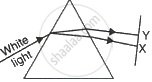
- State the colour seen
- at X, and
- at Y.
- Why do different colours of white light bend through different angles with respect to the incident beam of light?
Make two diagrams to explain refraction and dispersion.
Describe how you could demonstrate that white light is composed of a number of colours.
The speed of light in air or vacuum is
The property of splitting of white light into its seven constituent colours is known as
Out of air and glass, which is optically rarer? Give reason.
You are given a disc divided into seven sectors with colours violet, indigo, blue, green, yellow, orange and red in them. What would be its colour when it is rotated rapidly?
Define the term dispersion of light.
When we place a glass prism in the path of a narrow beam of white light a spectrum is obtained. What happens when a second identical prism is placed in an inverted position with respect to the first prism? Draw a labelled ray diagram to illustrate it.
Draw a labeled ray diagram to illustrate the dispersion of a narrow beam of white light when it passes through a glass prism.
If a monochromatic beam of light undergoes minimum deviation through an equiangular prism, how does the beam pass through the prism, with respect to its base?
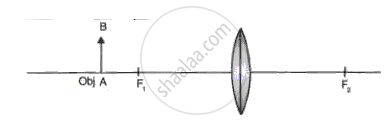
An object AB is placed in front of a convex lens as shown in fig. 4. Complete the ray diagram and obtain the image formed and state the nature of the image.
A wave has wavelength 50Å of State the speed in vacuum.
What is the cause of the dispersion of white light through a glass prism? Draw a ray diagram to show the path of light when two identical glass prisms are arranged together in an inverted position with respect to each other and a narrow beam of white light is allowed to fall obliquely on one of the faces of the prisms.
A student has to trace the path of a ray of light through a glass prism. List four precautions he should observe for better results.
Which characteristic property of light is responsible for the blue colour of the sky?
Write the range of wavelength of the ultraviolet spectrum.
The splitting of white light in to seven colors is called ______.
Why do we see a rainbow in the sky only after rainfall?
Assertion: We can see the rainbow in the sky when the rain starts falling after a spell of bright sunlight.
Reason: The rainbow is formed due to the dispersion of light.
