Advertisements
Advertisements
प्रश्न
The phenomena of light involved in the formation of rainbow are ______.
Which of the following phenomena of light are involved in the formation of a rainbow?
पर्याय
Reflection, refraction and dispersion
Refraction, dispersion and total internal reflection
Refraction, dispersion and internal reflection
Dispersion, scattering and total internal reflection
Advertisements
उत्तर
Refraction, dispersion and internal reflection
Explanation -
A rainbow is a natural spectrum of seven colours appearing in the sky after a rain shower. It is caused by dispersion of sunlight by tiny water droplets, present in the atmosphere. The water droplets act like small prisms. They refract and disperse the incident sunlight, then reflect it internally, and finally refract it again when it comes out of the raindrop.
APPEARS IN
संबंधित प्रश्न
In the following ray diagram the correctly marked angle are:

(a) ∠i and ∠e
(b) ∠A and ∠D
(c) ∠i, ∠e and ∠D
(d) ∠r, ∠A and ∠D
In the formation of spectrum of white light by a prism:
- which colour is deviated least?
- which colour is deviated most?
What is spectrum?
In the figure given alongside, a narrow beam of white light is shown to pass through a triangular glass prism. After passing through the prism, it produces a spectrum YX on the screen.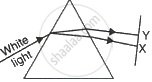
- State the colour seen
- at X, and
- at Y.
- Why do different colours of white light bend through different angles with respect to the incident beam of light?
In the figure given alongside, a narrow beam of white light is shown to pass through a triangular glass prism. After passing through the prism, it produces a spectrum YX on the screen.
Why do different colours of white light bend through different angles with respect to the incident beam of light?
Make two diagrams to explain refraction and dispersion.
A beam of white light falls on a glass prism. The colour of light which undergoes the least bending on passing through the glass prism is:
(a) violet
(b) red
(c) green
(d) blue
Which of the following colour of white light is least deviated by the prism?
(a) green
(b) violet
(c) indigo
(d) yellow
The splitting up of white light into seven colours on passing through a glass prism is called ______.
Explain the cause of dispersion of white light through a prism.
- A beam of monochromatic light undergoes minimum deviation through an equiangular prism, how does the beam pass through the prism, with respect to its base?
- If white light is used in the same way as in part (a) above, what change do you expect in the emergent beam?
- What conclusion do you draw about the nature of white light in part (b)?
What conclusion do you draw about the nature of white light in part (b)?
The frequency range of visible light is from 3.75 × 10¹⁴ Hz to 7.5 × 10¹⁴ Hz. Calculate its wavelength range. Take speed of light = 3 × 10⁸ m/s.
In the following diagram, the correctly marked angles are
(A) All
(B) Only ∠i and ∠A
(C) ∠i, ∠r and ∠A
(D) ∠i, ∠A and ∠D
In an experiment to trace the path of a ray of light through a triangular glass prism, a student would observe that the emergent ray
(a) is parallel to the incident ray.
(b) is along the same direction of incident ray.
(c) gets deviated and bends towards the thinner part of the prism.
(d) gets deviated and bends towards the thicker part (base) of the prism.
Draw a labeled ray diagram to illustrate the dispersion of a narrow beam of white light when it passes through a glass prism.
The phenomenon of splitting of light into its component colours is ___________ .
Which characteristic property of light is responsible for the blue colour of the sky?
Write the range of wavelength of the infrared spectrum.
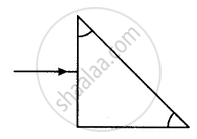
In the diagram, a narrow beam of white light is incident on a right-angled isosceles prism. The critical angle of the material of prism for the yellow colour of white light is 45°. Complete the diagram to show the path of blue, yellow, and red colours of white light till they emerge out of the prism.
Write an Explanation.
Critical angle
The splitting of white light in to seven colors is called ______.
What is dispersion? Explain in detail.
Name the scientist who was the first to use a glass prism to obtain the spectrum of sunlight.
Why do we see a rainbow in the sky only after rainfall?
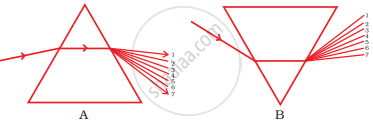
State the correct sequence (1-7) of colours in the spectrum formed by the prisms A and B, shown in the following figure.
What is Newton’s disc?
The periscope is an optical device with a polished surface that reflects the light falling on it.
The angle of deviation through a prism is minimum when

- Incident rays and emergent rays are symmetric to the prism.
- The refracted ray inside the prism becomes parallel to its base.
- The angle of incidence is equal to that of the angle of emergence.
- When the angle of emergence has doubled the angle of incidence.
Choose the correct answer from the options given below:
The dispersive powers of flint glass and crown glass are 0.053 and 0.034, respectively and their mean refractive indices are 1.68 and 1.53 for white light. Calculate the angle of the flint glass prism required to form an achromatic combination with a crown glass prism of refracting angle 4°:
