Advertisements
Advertisements
Question
Write three conditions necessary to obtain a pure spectrum on a screen. Name the instrument in which the conditions stated by you are fulfilled.
Advertisements
Solution
The three conditions necessary to obtain a pure spectrum on a screen are:
(i) A narrow parallel beam of light should be made incident on the prism.
(ii) The prism should be placed in the position of minimum deviation.
(iii) The emergent parallel beam should be focussed on the screen.
These conditions are fulfilled in the spectrometer.
RELATED QUESTIONS
Study the following figure in which a student has marked the angle of incidence (∠i), angle of refraction (∠r), angle of emergence (∠e), angle of prism (∠A) and the angle of deviation (∠D). The correctly marked angles are
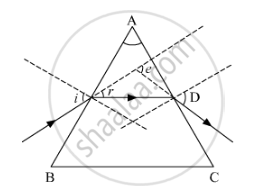
(a) ∠A and ∠i
(b) ∠A, ∠i and ∠r
(c) ∠A, ∠i, ∠e and ∠D
(d) ∠A, ∠i, ∠r and ∠D
Which of the following coloured light has the least speed in glass prism?
(a) violet
(b) yellow
(c) red
(d) green
While performing the experiment to trace the path of a ray of light passing through a glass prism, four students marked the incident ray and the emergent ray in their diagrams in the manner shown below. 
(A) I
(B) II
(C) III
(D) IV
A glass prism is able to produce the spectrum when white light passes through it, but a glass slab doesn’t produce any spectrum. Explain why it is so.
Answer the following:
What do you mean by dispersion? Name the different colours of light in the proper sequence in the spectrum of light.
Say TRUE or FALSE
After passing through a prism, white light splits into a band of seven colours
What is dispersion? Explain in detail.
Which of the following is a natural phenomenon which is caused by the dispersion of sunlight in the sky?
The periscope is an optical device with a polished surface that reflects the light falling on it.
State the colour which bends:
- The most.
- The least while passing through a glass prism.
