Advertisements
Advertisements
Question
The colour of white light which suffers the maximum bending (or maximum refraction) on passing through a glass prism is:
(a) yellow
(b) orange
(c) red
(d) violet
Advertisements
Solution
violet
The colour violet of white light suffers the maximum refraction on passing through a glass prism as it has the shortest wavelength.
APPEARS IN
RELATED QUESTIONS
Draw a ray diagram to show the dispersion of white light.
When a ray of light enters a prism, it bends ______ the normal; as it leaves the prism, it bends ______ the normal.
What acts as tiny prisms in the formation of a rainbow?
What are the seven colours seen in a rainbow?
A beam of white light falls on a glass prism. The colour of light which undergoes the least bending on passing through the glass prism is:
(a) violet
(b) red
(c) green
(d) blue
Why do you not see a spectrum of colours when light passes through a flat pane of glass?
A ray of white light is passed through a glass prism and a spectrum is obtained on a screen.
- Name the seven colours of the spectrum in order.
- Do the colours have the same width in the spectrum?
- Which of the colour of the spectrum of white light deviates (i) the most, (ii) the least?
A glass prism is able to produce the spectrum when white light passes through it, but a glass slab doesn’t produce any spectrum. Explain why it is so.
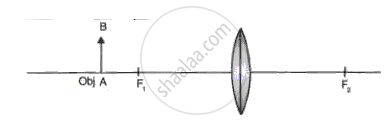
An object AB is placed in front of a convex lens as shown in fig. 4. Complete the ray diagram and obtain the image formed and state the nature of the image.
Make the correct choice for each of the following:
Which one of the following Fig correctly shows the path of the ray through the glass block?
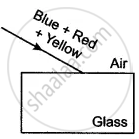
In the figure, a beam of light consisting of three colours blue, red, and yellow is incident on a prism and on a rectangular glass block respectively. Complete the diagram by drawings of the refracted and emergent rays.
Observe the given figure and write appropriate phenomenon of light in the box.
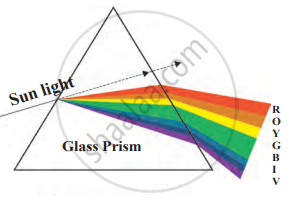
Observe the given figure and answer the following questions.
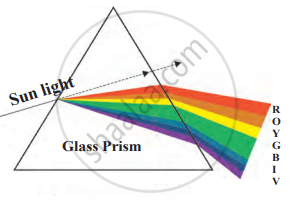
- Which colour light rays bend most?
- Which colour light rays bend least.
- What is the wavelength of violet light rays?
What is dispersion? Explain in detail.
The splitting of white light into its component colours is called ____________.
In dispersion, the color of light that will bend more is ______.
Assertion: We can see the rainbow in the sky when the rain starts falling after a spell of bright sunlight.
Reason: The rainbow is formed due to the dispersion of light.
The angle of deviation through a prism is minimum when

- Incident rays and emergent rays are symmetric to the prism.
- The refracted ray inside the prism becomes parallel to its base.
- The angle of incidence is equal to that of the angle of emergence.
- When the angle of emergence has doubled the angle of incidence.
Choose the correct answer from the options given below:
State the colour which bends:
- The most.
- The least while passing through a glass prism.
