Advertisements
Online Mock Tests
Chapters
2: Refraction of Light
▶ 3: The Human Eyes And The Colorful World
4: Electricity
5: Magnetic Effects of Electric Current
![Lakhmir Singh solutions for Physics Part 1 [English] Class 10 chapter 3 - The Human Eyes And The Colorful World - Shaalaa.com](/images/physics-part-1-english-class-10_6:5e8f817651d047a288d517e10b532fb7.jpg "Lakhmir Singh solutions for Physics Part 1 [English] Class 10 chapter 3 - The Human Eyes And The Colorful World")
Advertisements
Solutions for Chapter 3: The Human Eyes And The Colorful World
Below listed, you can find solutions for Chapter 3 of CBSE, Karnataka Board Lakhmir Singh for Physics Part 1 [English] Class 10.
Lakhmir Singh solutions for Physics Part 1 [English] Class 10 3 The Human Eyes And The Colorful World Exercise 1 [Pages 147 - 151]
Very Short Answer Type Questions
What kind of lens is present in the human eye?
Name two parts of the eye which refract light rays (or bend light rays).
Name the part of the eye:
Which controls the amount of light entering the eye?
Name the part of the eye:
on which the image is formed.
Name the part of the eye:
which changes the focal length of eye-lens.
What is the name of:
the curved, transparent front surface of the eye?
What is the name of:
the light-sensitive layer in the eye?
Where is the image formed in a human eye?
What is the function of the lens in the human eye?
What job does the pupil of the eye do?
How does the eye adjust to take account of an increase in brightness?
Name that part of the eye which is equivalent to the photographic film in a camera.
Name the part of the retina which is insensitive to light.
Which part of the eye contains cells which are sensitive to light?
Name two types of cells in the retina of an eye which respond to light.
Out of rods and cones m the retina of your eye:
which detect colour?
Out of rods and cones m the retina of your eye:
which work in dim light?
State whether the following statement is true or false:
The image formed on our retina is upside-down
What is the principal function of the eye-lens?
Where does the greatest degree of refraction of light occur in the eye?
What changes the shape of lens in the eye?
What do the ciliary muscles do when you are focusing on a nearby object?
What is the least distance of distinct vision for a normal human eye?
What is the:
far point of a normal human eye?
What is the:
near point of a normal human eye?
What is the range of vision of a normal human eye?
Name the part of our eyes which helps us to focus near and distant objects in quick succession.
Define the term.
Power of accommodation of the eye.
Give the scientific names of the following parts of the eye:
carries signals from an eye to the brain.
Give the scientific names of the following parts of the eye:
muscles which change the shape of the eye-lens.
Give the scientific names of the following parts of the eye:
a hole in the middle of the iris.
Give the scientific names of the following parts of the eye:
a clear window at the front of the eye.
Give the scientific names of the following parts of the eye:
changes shape to focus a picture on the retina.
Fill in the following blank with suitable word:
Most of the refraction of light rays entering the eye occurs at the outer surface of the.............
Fill in the following blank with suitable word:
The part of eye sensitive to light is...................
Fill in the following blank with suitable word:
The part of eye which alters the size of the pupil is............
Fill in the following blank with suitable words:
When light is dim, the pupil becomes................
Fill in the following blank with suitable word:
The iris controls the amount of................entering the eye.
The ciliary muscles control the shape of the ______.
Fill in the following blank with suitable word:
To bring light from a distant object to a focus on the retina of the eye, the convex eye-lens needs to be made..........
Fill in the following blank with suitable word:
To bring light from a near object to a focus on the retina of the eye, the convex eye-lens need to be made....................
Short Answer Type Questions
Why is a normal eye not able to see clearly the objects placed closer than 25 cm?
What changes take place in the shape of eye-lens:
when the eye is focused on a near object?
What changes take place in the shape of eye-lens:
when the eye is focused on a distant object?
The eyes of a person are focused (i) on a nearby object, and (ii) on a distant object, turn by turn. In which case:
the focal length of eye-lens will be the maximum?
The eyes of a person are focused (i) on a nearby object, and (ii) on a distant object, turn by turn. In which case:
the converging power of eye-lens will be the maximum?
What change is made in the eye to enable it to focus on objects situated at different distances? Illustrate your answer with the help of diagrams.
How is the amount of light entering the eye controlled?
What happens to the eye when you enter a darkened cinema hall from bright sunshine? Give reason for your answer.
Why does it take some time to see objects in a dim room when you enter the room from bright sunshine outside?
A person walking in a dark corridor enters into a brightly lit room:
State the effect on the pupil of the eye.
A person walking in a dark corridor enters into a brightly lit room:
How does this affect the amount of light entering the eye?
Ciliary muscles of human eye can contract or relax. How does it help in the normal functioning of the eye?
Describe and explain, how a normal eye can see objects lying at various distances clearly.
There are two types of light-sensitive cells in the human eye:
- Where are they found?
- What is each type called?
- To what is each type of cell sensitive?
What are rods and cones in the retina of an eye?
Why is our night vision relatively poor compared to the night vision of an owl?
How does the convex eye-lens differ from the ordinary convex lens made of glass?
List, in order, the parts of the eye through which light passes to reach the retina.
What happens to the size of the pupil of our eye in dim light?
What happens to the size of the pupil of our eye in bright light?
Name the cell on the retina of an eye which is sensitive to bright light.
Name the cell on the retina of an eye which is sensitive to dim light.
Name the cell on the retina of an eye which is sensitive to sensation of colour.
Long Answer Type Questions
- Draw a simple diagram of the human eye and label clearly the cornea, iris, pupil, ciliary muscles, eye-lens, retina, optic nerve and blind spot.
- Describe the working of the human eye with the help of the above diagram.
- How does the eye adjust itself to deal with light of varying intensity?
Explain the functions of the following part of the eye:
Cornea
Write the function of the following part of the human eye:
Iris
Explain the functions of the following part of the eye:
Pupil
State the functions of the following:
Ciliary muscles
Explain the functions of the following part of the eye:
Eye-lens
Write the function of the retina in the human eye.
Explain the functions of the following part of the eye:
Optic nerve
If you walk from a dark room into sunlight and back again into dark room, how would your pupils alter in size? What makes this happen?
Explain why, we cannot see our seats first when we enter a darkened cinema hall from bright light but gradually they become visible.
Multiple Choice Questions (MCQs)
The human eye forms the image of an object at its ______.
cornea
iris
pupil
retina
The change in focal length of an eye lens is caused by the action of the ______.
pupil
retina
ciliary muscles
iris
The least distance of distinct vision for a young adult with normal vision is about ______.
25 m
2.5 cm
25 cm
2.5 m
Refraction of light in the eye occurs at:
(a) the lens only
(b) the cornea only
(c) both the cornea and the lens
(d) the pupil
To focus the image of a nearby object on the retina of an eye:
(a) the distance between eye-lens and retina is increased
(b) the distance between eye-lens and retina is decreased
(c) the thickness of eye-lens is decreased
(d) the thickness of eye-lens is increased
The term " accommodation" as applied to the eye, refers to its ability to:
(a) control the light intensity falling on the retina
(b) erect the inverted image formed on the retina
(c) vary the focal length of the lens
(d) vary the distance between the lens and retina
Which of the following controls the amount of light entering the eye?
(a) ciliary muscles
(b) lens
(c) iris
(d) cornea
The human eye possesses the power of accommodation. This is the power to:
(a) alter the diameter of the pupil as the intensity of light changes
(b) distinguish between lights of different colours
(c) focus on objects at different distances
(d) decide which of the two objects is closer.
How does the eye change in order to focus on near or distant objects?
(a) The lens moves in or out
(b) The retina moves in or out
(c) The lens becomes thicker or thinner
(d) The pupil gets larger or smaller
Which of the following changes occur when you walk out of bright sunshine into a poorly lit room?
(a) the pupil becomes larger
(b) the lens becomes thicker
(c) the ciliary muscle relaxes
(d) the pupil becomes smaller
The size of the pupil of the eye is adjusted by:
(a) cornea
(b) ciliary muscles
(c) optic nerve
(d) iris
Questions Based on High Order Thinking Skills (HOTS)/Case Based Questions
The descriptions of five kinds of images are given below:
(a) diminished and virtual
(b) enlarged and real
(c) enlarged and erect
(d) real and inverted
(e) virtual and the same size
Which one of these describes the image formed:
(i) on the retina of the eye?
(ii) by a magnifying glass?
(iii) by a convex driving mirror on a car?
(iv) by a plane mirror?
(v) on the screen of a slide projector?
What shape are your eye-lenses:
when you look at your hand?
What shape are your eye-lenses:
when you look at a distant tree?
Suggest how your irises help to protect the retinas of your eyes from damage by bright light.
- Which parts of the eye cause rays of light to converge on the retina?
- Which part causes the greatest convergence?
- Which part brings the image into sharp focus on the retina? How does it do this?
An object is moved closer to an eye. What changes must take place in the eye in order to keep the image in sharp focus?
Why does the eye-lens not have to do all the work of converging incoming light rays?
Explain why, when it is getting dark at night, it is impossible to make out the colour of cars on the road.
Nocturnal animals (animals which sleep during the day and come out at night) tend to have wide pupils and lot of rods in their retinas. Suggest reasons for this.
Lakhmir Singh solutions for Physics Part 1 [English] Class 10 3 The Human Eyes And The Colorful World Exercise 2 [Pages 158 - 161]
Very Short Answer Type Questions
Name one of the common defects of vision and the type of lens used to remove it.
Name the defect of vision in a person:
whose near point is more than 25 on away.
Name the defect of vision in a person:
whose far point is less than infinity
Which defect of vision can be rectified:
by using a concave lens?
Which defect of vision can be rectified:
by using a convex lens?
What type of lens is used to correct
hypermetropia
What type of lens is used to correct
myopia?
What is the other name for
myopia
What is the other name for
hypermetropia
What is the scientific name of
short-sightedness
What is the scientific name of
long-sightedness?
What kind of lens is used to correct
short-sightedness
What kind of lens is used to correct
long-sightedness?
State whether the following statement is true or false:
Short-sightedness can be cured by using a concave lens.
Name the defect of vision in which the eye-lens loses its power of accommodation due to old age.
Name the defect of vision which makes the eye-lens cloudy resulting in blurred vision.
What is the other name of old age hypermetropia?
Name any two defects of vision which can be corrected by using spectacles.
Name one defect of vision (or eye) which cannot be corrected by any type of spectacle lenses.
Name the body part with which the terms myopia and hypermetropia are connected.
What is the far point of a person suffering from myopia (or short-sightedness)?
Where is the near point of a person suffering from hypermetropia (or long-sightedness)?
Your friend can read a book perfectly well but cannot read the writing on blackboard unless she sits on the front row in class.
- Is she short-sighted or long-sighted?
- What type of lenses-converging or diverging-would an optician prescribe for her?
A man can read the number of a distant bus clearly but he finds difficulty in reading a book.
- From which defect of the eye is he suffering?
- What type of spectacle lens should he use to correct the defect?
A student sitting in the last row of the class-room is not able to read clearly the writing on the blackboard.
- Name the type of defect he is suffering from.
- How can this defect by corrected?
Complete the following sentence:
A short-sighted person cannot see ............ objects clearly. Short-sightedness can be corrected by using ........... lenses.
Complete the following sentence.
A long-sighted person cannot see ........... objects clearly. Long-sightedness can be corrected by using .............. lenses.
Short Answer Type Questions
What are the two most common defects of vision (or defects of eye)? How are they corrected?
Differentiate between myopia and hypermetropia.
What type of spectacles should be worn by a person having the defects of myopia as well as hypermetropia? How does it help?
Name the defect of vision which can be corrected by a converging lens. Show clearly by a ray diagram how the lens corrects the defect.
Name the defect of vision which can be corrected by a diverging lens. Show clearly by a ray diagram how the lens corrects the defect.
Explain with the help of labelled ray diagram, the defect of vision called myopia and how it is corrected by a lens.
Explain with the help of labelled ray-diagram, the defect of vision called hypermetropia, and hot it is corrected by a lens.
A person suffering from the eye-defect myopia (short-sightedness) can see clearly only up to a distance of 2 metres. What is the nature and power of lens required to rectify this defect?
The near-point of a person suffering from hypermetropia is at 50 cm from his eye. What is the nature and power of the lens needed to correct this defect? (Assume that the near-point of the normal eye is 25 cm).
A person needs a lens of power -5.5 dioptres for correcting his distant vision. For correcting his near vision he needs a lens of power +1.5 dioptre. What is the focal length of the lens required for correcting (i) distant vision and (ii) near vision?
What is presbyopia?
Write two causes of presbyopia defect.
Name the type of lens used for the correction of the presbyopia defect.
When is a person said to have developed cataract in his eye? How is the vision of a person having cataract restored?
fill in the following blank with suitable word:
A person is short-sighted if his eyeball is too............Spectacles with a .............lens are needed. A person is long-sighted if his eyeball is too............Spectacles with a ................lens are needed. These focus light rays exactly on to the..........
Long Answer Type Questions
What is short-sightedness? State the two causes of short-sightedness (or myopia). With the help of ray diagrams, show:
(i) the eye-defect short-sightedness.
(ii) correction of short-sightedness by using a lens.
A person having short-sight cannot see objects clearly beyond a distance of 1.5 m. What would be the nature and power of the corrective lens to restore proper vision?
What is long-sightedness? State the two causes of long-sightedness (or hypermetropia). With the help of ray diagrams, show:
(i) the eye-defect long-sightedness.
(ii) correction of long-sightedness by using a lens.
An eye has a near point distance of 0.75 m. What sort of lens in spectacles would be needed to reduce the near point distance to 0.25 m? Also calculate the power of lens required. Is this eye long-sighted or short-sighted?
An eye has a far point of 2 m. What type of lens in spectacles would be needed to increase the far point to infinity? Also calculate the power of lens required. Is this eye long-sighted or short-sighted?
Multiple Choice Questions (MCQS)
The human eye can focus objects at different distances by adjusting the focal length of the eye lens. This is due to ______.
presbyopia
accommodation
near-sightedness
far-sightedness
The defect of vision which cannot be corrected by using spectacles is:
(a) myopia
(b) presbyopia
(c) cataract
(d) hypermetropia
A person cannot see the distant objects clearly (though he can see the nearby objects clearly). He is suffering from the defect of vision called:
(a) cataract
(b) hypermetropia
(c) myopia
(d) presbyopia
Though a woman can see the distant object clearly, she cannot see the nearby objects clearly. She is suffering from the defect of vision called:
(a) long-sight
(b) short-sight
(c) hind-sight
(d) mid-sight
A young man has to hold a book at arm's length to be able to read it clearly. The defect of vision is:
(a) astigmatism
(b) myopia
(c) presbyopia
(d) hypermetropia
After testing the eyes of a child, the optician has prescribed the following lenses for his spectacles:
Left eye : + 2.00 D
Right eye : + 2.25 D
The child is suffering from the defect of vision called:
(a) short-sightedness
(b) long-sightedness
(c) cataract
(d) presbyopia
A person got his eyes tested. The optician's prescription for the spectacles reads:
Left eye: − 3.00 D
Right eye: − 3.50 D
The person is having a defect of vision called:
(a) presbyopia
(b) myopia
(c) astigmatism
(d) hypermetropia
A student sitting on the last bench in the class cannot read the writing on the blackboard clearly but he can read the book lying on his desk clearly. Which of the following statement is correct about the student?
(a) The near point of his eyes has receded away.
(b) The near point of his eyes has come close to him.
(c) The far point of his eyes has receded away.
(d) The far point of his eyes has come closer to him.
A man driving a car can read a distant road sign clearly but finds difficulty in reading the odometer on the dashboard of the car. Which of the following statement is correct about this man?
(a) The near point of his eyes has receded away.
(b) The near point of his eyes has come closer to him.
(c) The far point of his eyes has receded away.
(d) The far point of his eyes has come closer to him.
The defect of vision in which the eye-lens of a person gets progressively cloudy resulting in blurred vision is called:
(a) myopia
(b) presbyopia
(c) colourblindness
(d) cataract
A person cannot see distant objects clearly. His vision can be corrected by using the spectacles containing:
(a) concave lenses
(b) plane lenses
(c) contact lenses
(d) convex lenses
A person finds difficulty in seeing nearby objects clearly. His vision can be corrected by using spectacles containing:
(a) converging lenses
(b) diverging lenses
(c) prismatic lenses
(d) chromatic lenses
Questions Based on High Order Thinking Skills (HOTS)/Case Based Questions
In a certain murder investigation, it was important to discover whether the victim was long-sighted or short-sighted. How could a detective decide by examining his spectacles?
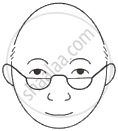
The picture given here shows a person wearing ‘half-moon’ spectacles. What sort of eye-defect do you think he has? Why are these particular spectacles useful to him?
A short-sighted person has a near point of 15 cm and a far point of 40 cm.
(a) Can he see clearly an object at a distance of:
(i) 5 cm?
(ii) 25 cm?
(iii) 50 cm?
(b) To see clearly an object at infinity, what kind of spectacle lenses does he need?
The near point of a long-sighted person is 50 cm from the eye.
- Can she see clearly an object at:
- a distance of 20 cm?
- at infinity?
- To read a book held at a distance of 25 cm, will she need converging or diverging spectacle lenses?
A person can read a book clearly only if he holds it at an arm's length from him. Name the defect of vision:
- if the person is an old man
- if the person is a young man
Lakhmir Singh solutions for Physics Part 1 [English] Class 10 3 The Human Eyes And The Colorful World Exercise 3 [Pages 163 - 288]
Very Short Answer Type Questions
How much is our field of view:
- with one eye open?
- with both eyes open?
Which of the following have a wider field of view?
(a) Animals having two eyes on the opposite sides of their head.
(b) Animals having two eyes at the front of their head.
Out of animals of prey and predators, which have their eyes:
- at the front of their head?
- on the opposite sides of their head?
State whether the following statement is true or false:
Rabbit has eyes which look sideways.
Fill in the following blank with suitable word:
Having two eyes gives a ................field of view.
Fill in the following blank with suitable word:
Having two eyes enables us to judge.................more accurately.
Short Answer Type Questions
What are the advantages of having two eyes instead of just one?
Explain clearly why, a person who has lost the sight of one eye is at a disadvantage compared with the normal person who has two good eyes.
Name two animals having eyes:
one the sides of the head.
Name two animals having eyes:
at the front of the head.
Among animals, the predators (like lions) have their eyes facing forward at the front of their heads, whereas the animals of prey (like rabbit) usually have eyes at the sides of their head. Why is this so?
Five persons A, B, C, D and E have diabetes, leukaemia, asthma, meningitis and hepatitis, respectively.
- Which of these persons can donate eyes?
- Which of these persons cannot donate eyes?
Multiple Choice Questions (MCQs)
The animal which does not have eyes that look sideways is:
(a) Horse
(b) Chicken
(c) Lion
(d) Fish
With both eyes open, a person's field of view is about:
(a) 90°
(b) 150°
(c) 180°
(d) 360°
Having two eyes gives a person:
(a) deeper field of view
(b) coloured field of view
(c) rear field of view
(d) wider field of view
The animals of prey have:
(a) two eyes at the front
(b) two eyes at the back
(c) two eyes on the sides
(d) one eye at the front and one on the side
The animals called predators have:
(a) both the eyes on the sides
(b) one eye on the side and one at the front
(c) one eye on the front and one at the back
(d) both the eyes at the front
- A ray of white light breaks up into its components while passing through a glass prism. Draw a ray diagram to show the path of rays.
- Mark the least deviated colour in your diagram.
- Why do different coloured rays deviate differently in a prism?
Lakhmir Singh solutions for Physics Part 1 [English] Class 10 3 The Human Eyes And The Colorful World Exercise 4 [Pages 169 - 171]
As light rays pass from air into a glass prism, are they refracted towards or away from the normal?
As light rays emerge from a glass prism into air, are they refracted towards or away from the normal?
Name a natural phenomenon which is caused by the dispersion of sunlight in the sky.
What information do we get about sunlight from the formation of a rainbow?
What did Newton demonstrate by his experiments with the prism?
What colours make up white light?
Give the meaning of the term VIBGYOR. With which phenomenon is it connected?
In the formation of spectrum of white light by a prism:
- which colour is deviated least?
- which colour is deviated most?
What colours lie on the two sides of the 'green colour' in the spectrum of white light?
Name the scientist who discovered that sunlight consists of seven colours.
What is the order of colours in a rainbow, from the outside to the inside?
Which colour of the spectrum has
longest wavelength,
Which colour of the spectrum has
shortest wavelength?
Which light has the longer wavelength : red light or blue light?
Which colour of light has the shorter wavelength − red or violet?
Fill in the blank with suitable word:
When a ray of light enters a prism, it bends ______ the normal; as it leaves the prism, it bends ______ the normal.
White light is composed of ______ colours. The colour of white light deviated through the largest angle by a prism is ______.
- A ray of white light breaks up into its components while passing through a glass prism. Draw a ray diagram to show the path of rays.
- Mark the least deviated colour in your diagram.
- Why do different coloured rays deviate differently in a prism?
What happens when a ray of ordinary light is passed through a triangular glass prism?
What will happen if another similar glass prism is placed upside down behind the first prism?
When a beam of white light is passed through a prism, it splits to form lights of seven colours. Is it possible to recombine the lights of seven colours to obtain the white light again? Explain your answer.
What is spectrum?
What is the name of the glass shape used to produce a spectrum?
How many colours are there in a full spectrum of white light? Write the various colours of spectrum in the order, starting with red.
What is meant by dispersion of white light? Describe the formation of rainbow in the sky with the help of a diagram.
In the figure given alongside, a narrow beam of white light is shown to pass through a triangular glass prism. After passing through the prism, it produces a spectrum YX on the screen.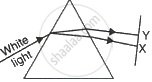
- State the colour seen
- at X, and
- at Y.
- Why do different colours of white light bend through different angles with respect to the incident beam of light?
Draw a diagram to show how white light can be dispersed into a spectrum by using a glass prism. Mark the various colours of the spectrum.
Make two diagrams to explain refraction and dispersion.
Describe how you could demonstrate that white light is composed of a number of colours.
How could you show that the colours of the spectrum combine to give white light?
Which is refracted most by a prism : red light or violet light? Explain why?
Long Answer Type Question
Draw a diagram to show the refraction of light through a glass prism. On this diagram, mark
(i) incident ray
(ii) emergent ray, and
(iii) angle of deviation.
What is a rainbow?
What are the two conditions necessary for the formation of a rainbow in the sky?
What acts as tiny prisms in the formation of a rainbow?
Name the process which is involved in the formation of a rainbow.
What are the seven colours seen in a rainbow?
Multiple Choice Questions (MCQs)
A beam of white light is shone onto a glass prism. The light cannot be:
(a) deviated
(b) dispersed
(c) focused
(d) refracted
A beam of white light falls on a glass prism. The colour of light which undergoes the least bending on passing through the glass prism is:
(a) violet
(b) red
(c) green
(d) blue
The colour of white light which suffers the maximum bending (or maximum refraction) on passing through a glass prism is:
(a) yellow
(b) orange
(c) red
(d) violet
Which of the following colour of white light is least deviated by the prism?
(a) green
(b) violet
(c) indigo
(d) yellow
The colour of white light which is deviated the maximum on passing through the glass prism is:
(a) blue
(b) indigo
(c) red
(d) orange
The splitting up of white light into seven colours on passing through a glass prism is called ______.
refraction
deflection
dispersion
scattering
reflection
Which of the following coloured light has the least speed in glass prism?
(a) violet
(b) yellow
(c) red
(d) green
The coloured light having the maximum speed in glass prism is ______.
blue
green
violet
yellow
Which of the following colour of white light has the least wavelength?
(a) red
(b) orange
(c) violet
(d) blue
Out of the following, the colour of light having the maximum wavelength is:
(a) violet
(b) indigo
(c) green
(d) orange
Questions Based on High Order Thinking Skills (HOTS)/Case Based Questions
Why do you not see a spectrum of colours when light passes through a flat pane of glass?
Name some everyday objects:
which reflect all the colours in sunlight
Name some everyday objects:
which absorb all the colours in sunlight
Where in nature can you find evidence that white sunlight may be made of different colours?
Lakhmir Singh solutions for Physics Part 1 [English] Class 10 3 The Human Eyes And The Colorful World Exercise 5 [Pages 173 - 175]
Very Short Answer Type Questions
Name the phenomenon which causes the twinkling of stars.
Name two effects produced by the atmospheric refraction.
Which phenomenon makes us see the sun:
a few minutes before actual sunrise?
Which phenomenon makes us see the sun:
a few minutes after actual sunset?
Atmospheric refraction causes advance sunrise and delayed sunset. By how much time is:
sunrise advanced?
Atmospheric refraction causes advance sunrise and delayed sunset. By how much time is:
sunset delayed?
State whether the following statement is true or false:
The planets twinkle at night due to atmospheric refraction of light.
Name the phenomenon due to which the stars seem higher in the sky than they actually are.
Fill in the following blank with suitable word:
We can see the sun about ................ minutes before the actual sunrise and about ................ minutes after the actual sunset because of atmospheric ................
Short Answer Type Questions
Why do stars seem higher than they actually are? Illustrate your answer with the help of a diagram.
Explain why, the sun can be seen about two minutes before actual sunrise. Draw a diagram to Illustrate your answer.
Explain why, if we look at objects through the hot air over a fire, the objects appear to be moving (or shaking) slightly.
What is atmospheric refraction?
What causes atmospheric refraction?
Why do stars twinkle on a clear night?
Explain why the planets do not twinkle.
Multiple Choice Questions (MCQs)
The twinkling of stars is due to atmospheric:
(a) reflection of light
(b) dispersion of light
(c) interference of light
(d) refraction of light
The atmospheric refraction of light causes the twinkling of:
(a) planets only
(b) stars only
(c) planets and stars
(d) stars and satellites
The stars appear higher in the sky than they actually are, due to:
(a) diffraction of light
(b) scattering of light
(c) refraction of light
(d) reflection of light
The stars twinkle but the planets do not twinkle at night because:
(a) the stars are small but the planets are large
(b) the stars are very large but planets are small
(c) the stars are much nearer but planets are far off
(d) the stars are far off but planets are nearer to earth
As light from a far off star comes down towards the earth:
(a) it bends away from the normal
(b) it bends towards the normal
(c) it does not bend at all
(d) it is reflected back
We can see the sun before the actual sunrise by about:
(a) 5 minutes
(b) 2 minutes
(c) 2 hours
(d) 20 minutes
Due to atmospheric refraction of sunlight, the time from sunrise to sunset is lengthened by about:
(a) 6 minutes
(b) 2 minutes
(c) 4 minutes
(d) 5 minutes
The day is longer on the earth by about 4 minutes because:
(a) the earth is round in shape
(b) the earth rotates on its axis
(c) the earth revolves around the sun
(d) the earth has atmosphere
Questions Based on High Order Thinking Skills (HOTS)/Case Based Questions
We know that light refracts (or bends) when it goes from one medium to another. Now, the atmosphere contains only air. Then how does light get refracted on passing through only air in the atmosphere?
By how much time the day would have been shorter if the earth had no atmosphere?
A student claims that because of atmospheric refraction, the sun can be seen after it has set, and the day is, therefore, longer than if the earth had no atmosphere.
- What does the student mean by saying that the sun can be seen after it has set?
- Do you think that the students’ conclusion is correct?
Lakhmir Singh solutions for Physics Part 1 [English] Class 10 3 The Human Eyes And The Colorful World Exercise 6 [Pages 178 - 179]
Very Short Answer Type Questions
What is the colour of the sunlight:
scattered by the dust particles in the atmosphere?
What is the colour of the sunlight scattered by the air molecules in the atmosphere?
Which of the two is scattered more easily, light of shorter wavelengths or light of longer wavelengths?
State whether the following statements are true or false:
The scattering away of red light makes the sky appear blue during the day time.
State whether the following statement is true or false:
Red coloured light has a longer wavelength but the blue coloured light has a shorter wavelength.
What colour does the sky appear to an astronaut?
Which effect is illustrated by the observation that when a beam of sunlight enters a dusty room, then its path becomes visible to us.
State one effect produced by the scattering of light by the atmosphere.
Short Answer Type Questions
What is tyndall effect? Explain with an example.
What happens when a beam of sunlight enters a dusty room through a window? Explain your answer.
Why does the sky appear blue on a clear day?
Why does the sky appear dark (or black) to an astronaut instead of blue?
Why are the ‘danger signal’ lights red in colour?
Draw a neat and labelled diagram to show why the sky appears blue.
Out of blue light and red light, which one is scattered more easily?
What causes the scattering of blue component of sunlight in the atmosphere?
Multiple Choice Questions (MCQs)
The blue colour of sky is due to:
(a) refraction of light
(b) dispersion of light
(c) diffraction of light
(d) scattering of light
Which of the following is not caused by the atmospheric refraction of light?
(a) twinkling of stars at night
(b) sun appearing higher in the sky than it actually is
(c) sun becoming visible two minutes before actual sunrise
(d) sun appearing red at sunset
The sky appears blue because some of the blue component of sunlight is scattered by:
(a) gas molecules present in air
(b) dust particles present in air
(c) water droplets suspended in air
(d) soot particles present in air
Questions Based on High Order Thinking Skills (HOTS)/Case Based Questions
When a beam of sunlight enters a closed room through a window, then its path becomes visible to us. And when a beam of sunlight passes through the canopy of a dense forest, even then its path becomes visible to us.
- What makes the path of sunlight beam entering through a window into a closed room visible to us?
- What makes the path of sunlight beam passing through a canopy of dense forest visible to us?
- Name the scientist who studied the above phenomena.
Lakhmir Singh solutions for Physics Part 1 [English] Class 10 3 The Human Eyes And The Colorful World Exercise 7 [Page 179]
Questions Based on Assertion-Reason
In the following questions, two statements are given-one labelled Assertion (A) and the other labelled Reason (R): Select the correct answer to these questions from the options given below:
Assertion (A): An eye can focus the images of the distant objects as well as the nearby objects on its retina by changing the diverging power of its lens.
Reason (R): The ability of an eye to focus the distant objects as well as the nearby objects on the retina by changing the converging power of its lens is called accommodation.
Both A and R are true and R is correct explanation of the assertion.
Both A and R are true but R is not the correct explanation of the assertion.
A is true but R is false.
A is false but R is true.
Assertion (A): The defect of eye called myopia is caused due to the short focal length of eye-lens or due to eye-ball being too long.
Reason (R): Myopia is corrected by using spectacles containing diverging lenses (which decrease the converging power of the eye-lens).
Both A and R are true and R is correct explanation of the assertion.
Both A and R are true but R is not the correct explanation of the assertion.
A is true but R is false.
A is false but R is true.
Assertion (A): The defect of eye called hypermetropia is caused because of large focal length of the eye-lens or due to eye-ball being too short.
Reason (R): Hypermetropia is corrected by using spectacles containing concave lenses.
Both A and R are true and R is correct explanation of the assertion.
Both A and R are true but R is not the correct explanation of the assertion.
A is true but R is false.
A is false but R is true.
Assertion (A): In refraction through a glass slab, the emergent ray is parallel to the incident ray but in refraction through a glass prism, the emergent ray is not parallel to the incident ray.
Reason (R): The emergent ray of light in a glass prism is not parallel to the incident ray of light because the opposite faces of glass prism (where refraction takes place) are not parallel to one another. The opposite faces of a glass slab are, however, parallel to one another.
Both A and R are true and R is correct explanation of the assertion.
Both A and R are true but R is not the correct explanation of the assertion.
A is true but R is false.
A is false but R is true.
Assertion (A): The splitting up of white light into seven colours on passing through a transparent medium like a triangular glass prism is called dispersion of light.
Reason (R): The rainbow is an arch of seven colours visible in the sky which is produced by the dispersion of sun’s light by the tiny raindrops in the atmosphere.
Both A and R are true and R is correct explanation of the assertion.
Both A and R are true but R is not the correct explanation of the assertion.
A is true but R is false.
A is false but R is true.
Solutions for 3: The Human Eyes And The Colorful World
Lakhmir Singh solutions for Physics Part 1 [English] Class 10 chapter 3 - The Human Eyes And The Colorful World
Shaalaa.com has the CBSE, Karnataka Board Mathematics Physics Part 1 [English] Class 10 CBSE, Karnataka Board solutions in a manner that help students grasp basic concepts better and faster. The detailed, step-by-step solutions will help you understand the concepts better and clarify any confusion. Lakhmir Singh solutions for Mathematics Physics Part 1 [English] Class 10 CBSE, Karnataka Board 3 (The Human Eyes And The Colorful World) include all questions with answers and detailed explanations. This will clear students' doubts about questions and improve their application skills while preparing for board exams.
Further, we at Shaalaa.com provide such solutions so students can prepare for written exams. Lakhmir Singh textbook solutions can be a core help for self-study and provide excellent self-help guidance for students.
Concepts covered in Physics Part 1 [English] Class 10 chapter 3 The Human Eyes And The Colorful World are .
Using Lakhmir Singh Physics Part 1 [English] Class 10 solutions The Human Eyes And The Colorful World exercise by students is an easy way to prepare for the exams, as they involve solutions arranged chapter-wise and also page-wise. The questions involved in Lakhmir Singh Solutions are essential questions that can be asked in the final exam. Maximum CBSE, Karnataka Board Physics Part 1 [English] Class 10 students prefer Lakhmir Singh Textbook Solutions to score more in exams.
Get the free view of Chapter 3, The Human Eyes And The Colorful World Physics Part 1 [English] Class 10 additional questions for Mathematics Physics Part 1 [English] Class 10 CBSE, Karnataka Board, and you can use Shaalaa.com to keep it handy for your exam preparation.
