Advertisements
Advertisements
Question
Name the defect of vision in which the eye-lens loses its power of accommodation due to old age.
Advertisements
Solution
Presbyopia is the defect of vision because of which the eye lens loses its power of accommodation because of old age.
APPEARS IN
RELATED QUESTIONS
Explain with the help of labelled ray diagram, the defect of vision called myopia and how it is corrected by a lens.
Though a woman can see the distant object clearly, she cannot see the nearby objects clearly. She is suffering from the defect of vision called:
(a) long-sight
(b) short-sight
(c) hind-sight
(d) mid-sight
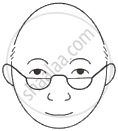
The picture given here shows a person wearing ‘half-moon’ spectacles. What sort of eye-defect do you think he has? Why are these particular spectacles useful to him?
Name the following:
The eye defect caused due to shortening of the eye ball from front to back.
A student has difficulty reading the blackboard while sitting in the last row. What could be the defect the child is suffering from? How can it be corrected?
When do we consider a student sitting in the class to be myopic? List two causes of this defect. Explain using a ray diagram how this defect of eye can be corrected.
Given alongside is a diagram depicting a defect of the human eye. Study the same and then answer the questions that follow:
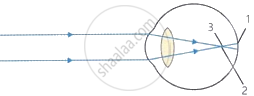
- Identify the defect.
- Name the parts labelled 1, 2 and 3.
- Give two possible reasons for this eye defect.
- Draw a labelled diagram to show how the above mentioned defect is rectified.
Have a look at the posture of this woman who is reading a book and answer the questions which follow:

What are the two conditions shown in sections A and B of the eye as applicable to her?
Have a look at the posture of this woman who is reading a book and answer the questions which follow:

What kind of looking glasses she needs?
Name the common defects of the eye.
Differentiate between:
Myopia and Hypermetropia.
Explain the Term: Cataract
Name the following:
The defect of the human eye caused due to the uneven surface of the cornea.
Nearsightedness: elongated eyeball : : farsightedness: _______
Myopia may arise due to ____________.
Which of the following statement is correct?
A person needs a lens of power –4.5 D for correction of her vision.
- What kind of defect in vision is she suffering from?
- What is the focal length of the corrective lens?
- What is the nature of the corrective lens?
Have a look at the posture of this girl who is reading a book and answer the questions which follow:
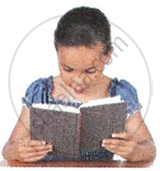 |
- Name the problem she is facing.
- What are the two conditions shown in sections A and B of the eye as applicable to her.
- What kind of reading glasses does she need?
 |
 |
| A | B |
