Advertisements
Advertisements
Question
Explain with the help of labelled ray diagram, the defect of vision called myopia and how it is corrected by a lens.
Advertisements
Solution
Myopia is a defect of vision because of which a person is unable to see distant objects clearly but has normal near vision. Myopia occurs because the converging power of the eye lens is greater than normal and the images of distant objects are formed in front of the retina. As a result, a person with myopia cannot see these objects clearly. In certain other cases, myopia occurs because the eyeball is too long and the distance of the retina from the eye lens is large. This, too, causes the formation of images in front of the retina. The far point of a myopic eye is closer than infinity. The following ray diagram explains the myopic eye and how the defect can be corrected by using concave lenses. A concave lens diverges the light rays from distant objects to form virtual images of the objects at the far point of eye. The eye lens then easily focusses the light rays from the far point to form clear images on the retina.

APPEARS IN
RELATED QUESTIONS
In a Std. X class out of 40 students 10 students use spectacles, 2 students have positive power and 8 students have negative power of lenses in their spectacles.
Answer the following questions:
(1) What does the negative power indicate?
(2) What does the positive power indicate?
(3) Generally which type of spectacles do most of the students use?
(4) What defect of eyesight do most of the students suffer from?
(5) Give two possible reasons for the above defect.
The far point of a myopic person is 80 cm in front of the eye. What is the nature and power of the lens required to correct the problem?
Which defect of vision can be rectified:
by using a concave lens?
Differentiate between myopia and hypermetropia.
An eye has a near point distance of 0.75 m. What sort of lens in spectacles would be needed to reduce the near point distance to 0.25 m? Also calculate the power of lens required. Is this eye long-sighted or short-sighted?
Though a woman can see the distant object clearly, she cannot see the nearby objects clearly. She is suffering from the defect of vision called:
(a) long-sight
(b) short-sight
(c) hind-sight
(d) mid-sight
By closing the eyes and gently pressing them by your palms, you may see some specks of brilliant light. How do you get this sensation while there is no light entering your eyes?
A person cannot read newspaper placed nearer than 50 cm from his eyes. Name the defect of vision he is suffering from. Draw a ray diagram to illustrate this defect. List its two possible causes. Draw a ray diagram to show how this defect may be corrected using a lens of appropriate focal length.
Distinguish between the following pair of words:
Myopia and hypermetropia
Given below is a diagram depicting a defect of the human eye? Study the same and answer the question that follow :
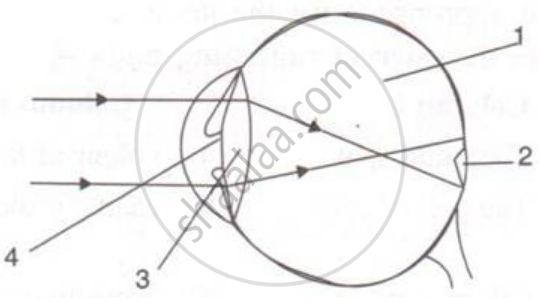
Name the type of lens used to correct this eye defect.
Have a look at the posture of this woman who is reading a book and answer the questions which follow:

What are the two conditions shown in sections A and B of the eye as applicable to her?
Differentiate between:
Myopia and Hypermetropia.
Draw a neat labeled diagram to show how hypermetropia can be rectified.
Explain the Term: Cataract
Name the following:
The defect of the human eye caused due to the uneven surface of the cornea.
Choose the Odd One Out:
Nearsightedness : concave lens : : farsightedness : _______
Differentiate the eye defects: Myopia and Hypermetropia
A student sitting at the back of the classroom cannot read clearly the letters written on the blackboard. What advice will a doctor give to her? Draw ray diagram for the correction of this defect.
Observe the figure and answer the following questions:

- Name the defect of vision represented in the above figure.
- State the reasons for this defect.
- How is it corrected?
- Draw the diagram to show the correction of this defect.
