Advertisements
Advertisements
Question
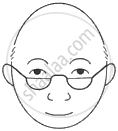
The picture given here shows a person wearing ‘half-moon’ spectacles. What sort of eye-defect do you think he has? Why are these particular spectacles useful to him?
Advertisements
Solution
As the person is wearing half-moon spectacles, he should be suffering from the eye defect called long-sightedness, or hypermetropia, because his spectacles are fitted with a convex lens. The convex lenses form the images of nearby objects at the near point of his eye, and he can, therefore, see these objects clearly.
APPEARS IN
RELATED QUESTIONS
Name the defect of vision in a person:
whose near point is more than 25 on away.
Name the body part with which the terms myopia and hypermetropia are connected.
Your friend can read a book perfectly well but cannot read the writing on blackboard unless she sits on the front row in class.
What type of lenses-converging or diverging-would an optician prescribe for her?
What are the two most common defects of vision (or defects of eye)? How are they corrected?
By closing the eyes and gently pressing them by your palms, you may see some specks of brilliant light. How do you get this sensation while there is no light entering your eyes?
Explain the terms ‘adaptation’ and ‘accommodation’ with reference to the eye.
Given below is a diagram depicting a defect of the human eye. Study the same and answer the question that follow:

Name the defect shown in the diagram.
State one role of ciliary muscles in the human eye.
What eye defect is hypermetropia? Describe with a ray diagram how this defect of vision can be corrected by using an appropriate lens.
A student has difficulty reading the blackboard while sitting in the last row. What could be the defect the child is suffering from? How can it be corrected?
The near point of the eye of a person is 50 cm. Find the nature and power of the corrective lens required by the person to enable him to see clearly the objects placed at 25 cm from the eye?
Name the common defects of the eye.
Explain the Term: Presbyopia
What type of lens is used to correct Hypermetropia?
Given below is a diagram showing a defect of vision. Name the defect of vision and draw an accurately labelled diagram to correct this defect.
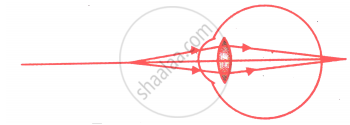
Differentiate the eye defects: Myopia and Hypermetropia
Observe the figure and answer the following questions:

- Name the defect of vision represented in the above figure.
- State the reasons for this defect.
- How is it corrected?
- Draw the diagram to show the correction of this defect.
A person is unable to see clearly a poster fixed on a distant wall. He however sees it clearly when standing at a distance of about 2 m from the wall.
- Draw ray diagram to show the formation of image by his eye lens when he is far away from the wall.
- List two possible reasons of this defect of vision.
- Draw ray diagram to show the correction of this defect using appropriate lens.
Match the following:
| Column - I | Column - II |
| 1. Retina | a. Path way of light |
| 2. Pupil | b. Far point comes closer |
| 3. Ciliary muscles | c. near point moves away |
| 4. Myopia | d. Screen of the eye |
| 5. Hypermetropia | e. Power of accommodation |
