Advertisements
Advertisements
Question
Differentiate the eye defects: Myopia and Hypermetropia
Advertisements
Solution
| Myopia | Hypermetropia |
| Myopia, also known as short-sightedness, occurs due to the lengthening of the eyeball. | Hypermetropia, also known as long-sightedness, occurs due to the shortening of the eyeball. |
| With this defect, nearby objects can be seen clearly but distant objects cannot be seen clearly. | With this defect, distant objects can be seen clearly but nearby objects cannot be seen clearly. |
| The focal length of the eye lens is reduced or the distance between the eye lens and retina increases. | The focal length of the eye lens is increased or the distance between the eye lens and retina decreases. |
| The far point will not be infinity for such eyes and the far point has come closer. | Hence, the near point will not be at 25 cm for such eyes and the near point has moved farther. |
| Due to this, the image of distant objects is formed before the retina. | Due to this, the image of nearby objects is formed behind the retina. |
| This defect can be corrected using a concave lens | This defect can be corrected using a convex lens. |
APPEARS IN
RELATED QUESTIONS
A person with a myopic eye cannot see objects beyond 1.2 m distinctly. What should be the type of the corrective lens used to restore proper vision?
Name the defect of vision in a person:
whose near point is more than 25 on away.
Name the defect of vision which can be corrected by a converging lens. Show clearly by a ray diagram how the lens corrects the defect.
A person is unable to read a book placed closer than 1 meter from his eyes. Identify the defect of vision in his eyes. Draw the ray diagrams to show the defect of vision and its correction.
Draw a ray diagram to show how Hypermetropia is defect can be corrected using a lens.
Explain the Term: Astigmatism
What are the causes of ‘Myopia’?
Assertion: Concave mirrors are used as reflectors in torches, vehicle head lights and in search lights.
Reason: When an object is placed beyond the center of curvature of a concave mirror, the image formed is real and inverted.
Observe the following diagram and answer questions following it:

- Identify the defect of vision shown.
- List its two causes.
- Name the type of lens used for the correction of this defect.
Have a look at the posture of this girl who is reading a book and answer the questions which follow:
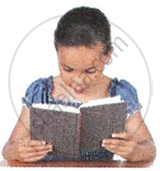 |
- Name the problem she is facing.
- What are the two conditions shown in sections A and B of the eye as applicable to her.
- What kind of reading glasses does she need?
 |
 |
| A | B |
