Advertisements
Advertisements
Question
Explain the rules for obtaining images formed by a convex lens with the help of ray diagram.
Advertisements
Solution
- Rule 1: When a ray of light strikes the convex or concave lens obliquely at its optical centre, it continues to follow its path without any deviation.

Rays passing through the optical centre - Rule-2: When rays parallel to the principal axis strikes a convex or concave lens, the refracted rays are converged to (convex lens) or appear to diverge from (concave lens) the principal focus

Rays passing parallel to the optic axis - Rule-3: When a ray passing through (convex lens) or directed towards (concave lens) the principal focus strikes a convex or concave lens, the refracted ray will be parallel to the principal axis
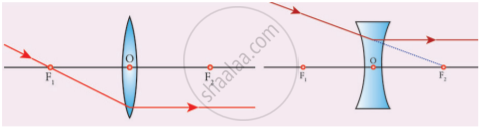
Rays passing through or directed towards the principal focus
APPEARS IN
RELATED QUESTIONS
A lens forms an upright and diminished image of an object when the object is placed at its focal point. Name the lens and draw a ray diagram to show the image formation.
A lens forms an inverted image of an object. What is the nature of the image real or virtual?
An object is placed at a distance of more than 40 cm from a convex lens of focal length 20 cm. The image formed is real, inverted and ______.
An object is placed at a distance 2f from a convex lens of focal length f. The size of the image formed is ______ that of the object.
For the object placed between the optical centre and focus of a convex lens, the image is ______.
Where should an object be placed so that a real and inverted image of the same size is obtained by a convex lens?
Sudha finds out that the sharp image of the window pane of her science laboratory is formed at a distance of 15 cm from the lens. She now tries to focus the building visible to her outside the window instead of the window pane without disturbing the lens. In which direction will she move the screen to obtain a sharp image of the building? What is the approximate focal length of this lens?
Draw ray diagrams showing the image formation by a convex lens when an object is placed
- between optical centre and focus of the lens
- between focus and twice the focal length of the lens
- at twice the focal length of the lens
- at infinity
- at the focus of the lens
A student focussed the image of a candle flame on a white screen using a convex lens. He noted down the position of the candle screen and the lens as under
Position of candle = 12.0 cm
Position of convex lens = 50.0 cm
Position of the screen = 88.0 cm
- What is the focal length of the convex lens?
- Where will the image be formed if he shifts the candle towards the lens at a position of 31.0 cm?
- What will be the nature of the image formed if he further shifts the candle towards the lens?
- Draw a ray diagram to show the formation of the image in case (iii) as said above.
A lens forms an upright and magnified image of an object. Draw a labelled ray diagram to show the image formation.
